Safety and Security Film Security window film is one of the most cost-effective physical hardening measures available for commercial buildings. It holds glass together on impact, significantly slowing forced entry through doors, sidelights, and storefront glass — buying critical time during a break-in or active threat event. When anchored to the frame with a wet-seal system, security film also provides blast mitigation protection for buildings in high-risk locations.
In Chicago, security film is specified most frequently for CPS and private school entry vestibules and ground-floor classrooms, hospital emergency department and pharmacy glass, first-floor retail storefronts on high-traffic commercial corridors, municipal buildings and police facilities, and corporate office entry points and reception areas. We install security film from 4-mil protective-grade through 12-mil blast-mitigation-grade depending on the threat profile and building requirements. Learn more about safety and security film →
School Safety Film Chicago Public Schools and private schools throughout the city have increasingly incorporated security window film into their physical safety plans. Film reinforces entry vestibule glass, delays unauthorized access through sidelights and door panels, and reduces glass fragmentation hazard during weather events or impact. We work with school administrators and facility directors on phased installations, procurement documentation, and grant-supported projects. Learn more about school safety film →
Solar Control Film Chicago’s combination of hot summers, intense southern and western sun angles, and an enormous inventory of glass-curtain commercial buildings creates significant demand for solar control window film. Glass-intensive buildings along Wacker Drive, Michigan Avenue, the River North and Fulton Market corridors, and the office parks throughout the northwest and west sides generate serious heat gain on south and west-facing exposures — leading to hot spots, glare on workstations and patient areas, and HVAC systems running at overcapacity.
Solar control film reduces heat transmission through existing glass by 40–70%, cuts glare dramatically, and lowers cooling load without requiring glass replacement. For older buildings with single-pane or early-generation insulated glazing, solar film is often the most practical and cost-effective energy upgrade available. Learn more about solar control film →
Low-E Window Film For Chicago buildings facing both hot summers and cold winters, Low-E window film offers year-round performance. It reduces solar heat gain in summer while improving thermal retention in winter, addressing both sides of Chicago’s seasonal energy challenge in a single installation. Particularly effective for older buildings with large glass exposures that have not been retrofitted with modern insulated glazing. Learn more about Low-E window film →
Privacy Film Privacy film is one of the most versatile products in our portfolio and sees broad application throughout Chicago’s commercial building stock. Common uses include healthcare exam rooms, therapy and counseling offices, behavioral health facilities, open-plan office glass partitions, conference rooms in Class A buildings, street-level storefronts where controlled visibility is a business requirement, and interior architectural glass in hotels and hospitality properties.
We offer one-way mirror film (daytime privacy), frosted and etched-look film, dual-reflective film, and blackout film depending on the application. Every recommendation starts with a site assessment — privacy film performance is highly dependent on interior versus exterior lighting conditions and glass orientation. Learn more about privacy film →
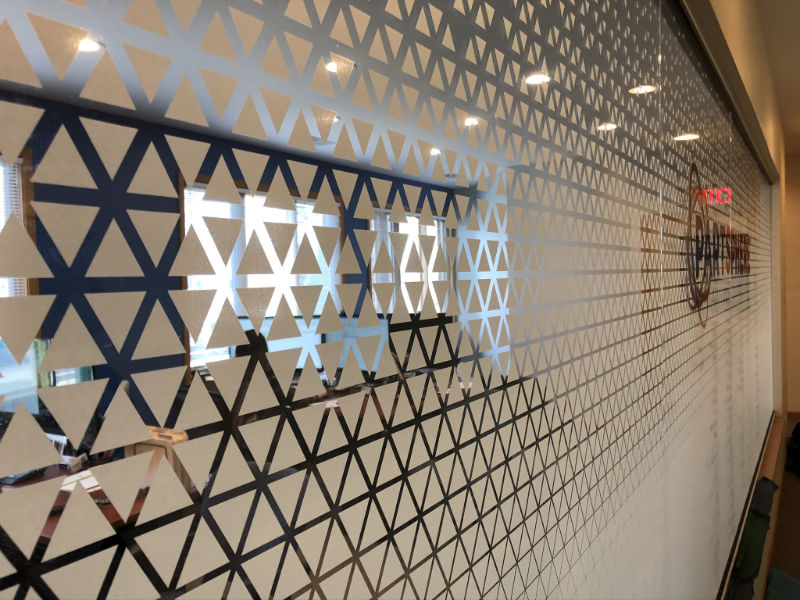
Decorative Film Decorative window film is widely used in Chicago’s corporate office buildouts, healthcare system interiors, hotel lobbies, restaurant and retail spaces, and educational facilities. It transforms plain glass into a branded or designed element — logos, patterns, gradients, frosted geometrics — without the cost or permanence of etched or sandblasted glass.
For Chicago property managers and facility directors overseeing tenant buildouts or common area renovations, decorative film offers a durable, removable, and professionally finished option that can be customized to match brand standards or architectural guidelines. Learn more about decorative film →
Anti-Graffiti Film Anti-graffiti film is a high-priority product for Chicago storefronts, transit-adjacent properties, parking structures, and any commercial glass exposed to tagging, etching, or acid graffiti. The sacrificial film absorbs damage and is replaced at a fraction of the cost of replacing the glass underneath. It is one of the most straightforward ROI calculations in the window film category — a single prevented glass replacement typically pays for a full anti-graffiti installation many times over.
High-demand areas in Chicago include commercial corridors along Milwaukee Avenue, Division Street, North Avenue, Cermak Road, 63rd Street, and transit station adjacencies throughout the Blue, Red, Green, and Orange lines. Learn more about anti-graffiti film →
Bird Strike Film Chicago is one of the most dangerous cities in North America for migratory birds. The city sits directly on the Mississippi Flyway, and the combination of tall glass buildings, lakefront orientation, and dense commercial development creates significant bird collision risk — particularly during spring and fall migration. Several Chicago institutions have adopted bird-friendly building guidelines, and bird strike film is increasingly specified in new construction and renovation projects.
Bird strike film uses a UV-visible dot or line pattern printed or applied to glass that is nearly invisible to the human eye but clearly detectable by birds in flight. It is appropriate for any Chicago building with significant glass exposure adjacent to parks, the lakefront, the Chicago River, or tree canopy. Learn more about bird strike film →