
Privacy and Decorative
What Are the Privacy Options for a Glass Conference Room?
Most glass conference rooms get frosted window film, over the full panel or as a band at eye level, because it blocks the view day and night and still passes daylight. Gradients and patterns suit rooms where design matters. Casper cloaking film hides screen content while the glass stays clear. No film blocks sound.
For most glass conference rooms, the answer is frosted window film, either over the full panel or as a band at eye level. It blocks the view in day and night and still lets daylight through. Gradient and patterned films are chosen when the design matters as much as the privacy, and Casper cloaking film hides what is on the screens while the glass stays clear. No window film makes a room soundproof; speech privacy depends on the walls, doors and ceiling.
Key points
- Solid frost is the most common conference room choice in our work. A frosted band at seated and standing eye level keeps clear glass above and below for light and openness.
- Frosted, gradient and patterned films screen the view wherever they cover the glass, day and night. Reflective one-way film loses its privacy after dark.
- Casper cloaking film hides content on compatible screens, most office LED displays at least 40 inches wide according to its maker, Designtex. It does not hide people or paper.
- Film blocks sight, not sound. GSA guidance calls for room enclosures rated at least STC 45 where conversations must stay confidential.
- Switchable glass is available but expensive, and it is not practical for most offices.
- Decorative films from 3M, SOLYX and Solar Gard that we reviewed test in the ASTM E84 Class A range. Interior warranties, ultraviolet blocking and roll widths differ by brand and product, so check the data sheet for the exact film.
What are the privacy options for a glass conference room?
There are six common approaches. They differ in what they hide, whether they work at night, and how much of the room’s openness they keep.
| Option | What it hides | Works at night? | Keeps light and openness | Usually chosen when |
|---|---|---|---|---|
| Solid frosted film, full panel | Everything behind the film; silhouettes can show close to the glass | Yes | Daylight yes, view no | The room needs full visual privacy |
| Frosted band | Seated and standing eye level | Yes, where the band covers | Yes, above and below the band | The goal is privacy without closing the room in |
| Gradient film | The denser part of the fade | Yes, where it is dense | Yes, toward the clear edge | Design is part of the project |
| Patterned or custom decorative film | As much as the pattern covers | Yes, where it covers | Depends on the pattern | The room needs branding or a design element |
| Casper cloaking film | Content on compatible screens only | Yes | Yes, the glass looks nearly clear | Screens are the concern, not people |
| Switchable glass | Everything, when switched on | Yes | Clear when switched off | Budget allows and the room must change on demand |
Two other films come up for conference rooms on outside walls. Dark reflective film gives daytime privacy and controls heat and glare, but people outside can see into a lit room at night. Blackout film blocks both view and daylight. We explain the night problem in Does Privacy Window Film Work at Night?
Which option do most offices choose?
Solid frost. It is the most common privacy choice in our conference room work because it is simple, it works the same at noon and at 9 PM, and it still passes daylight. Most of the frosted film we install comes from SOLYX and Solar Gard.
The usual decision is how much of the glass to cover. Full coverage gives the most privacy. A band keeps the room feeling open. A properly positioned frosted band can obscure people seated at the table while the glass above and below stays clear. How well it works depends on the band’s height, the furniture, the lighting and where people stand, so we set the height by checking sight lines from inside and outside the room. A 48 inch band is common in our conference room and huddle room work.
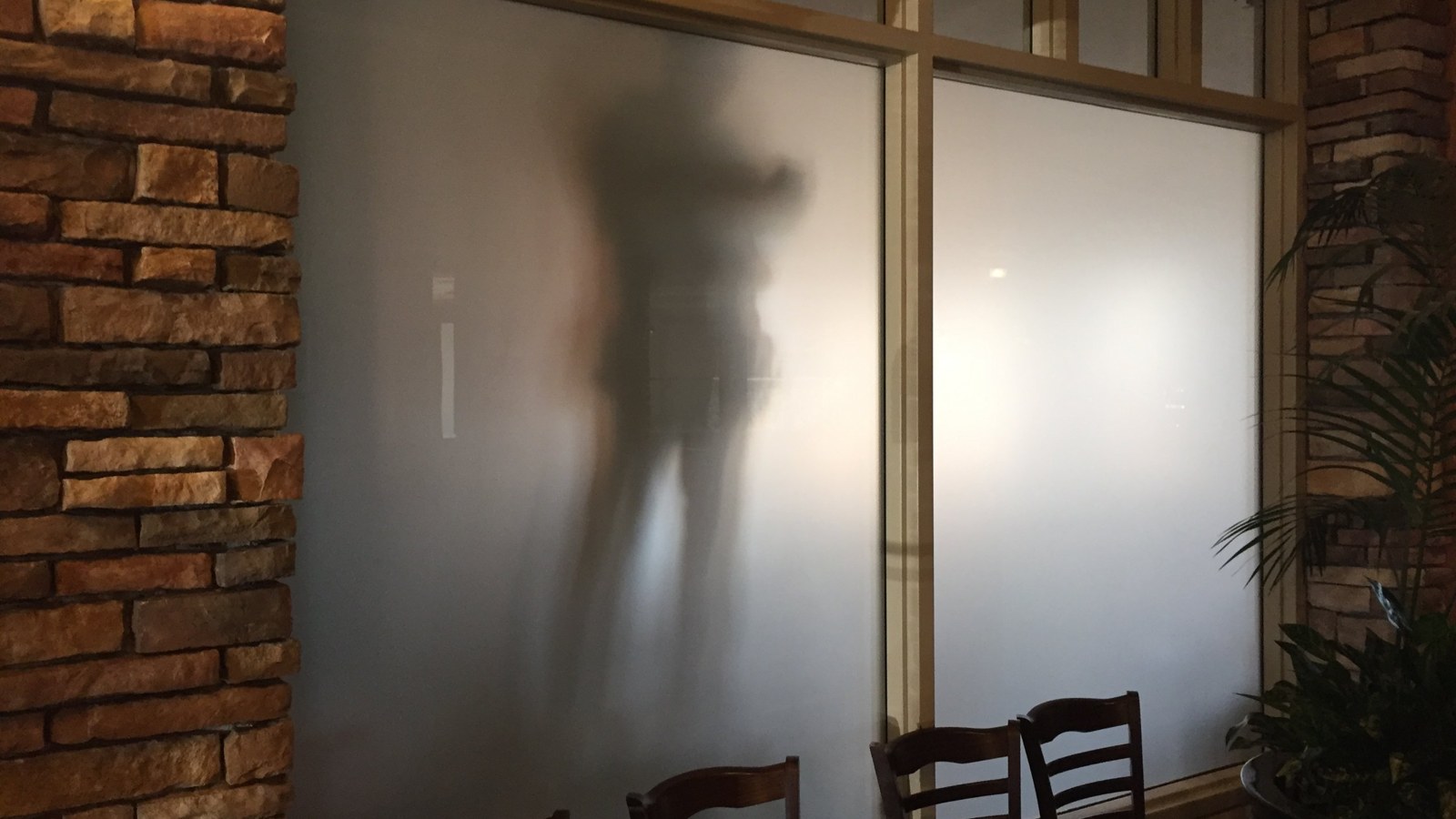
Frosted film does have limits. A person standing close to brightly lit frosted glass can show as a silhouette, and whatever is left clear stays clear.
When do gradients and patterns make sense?
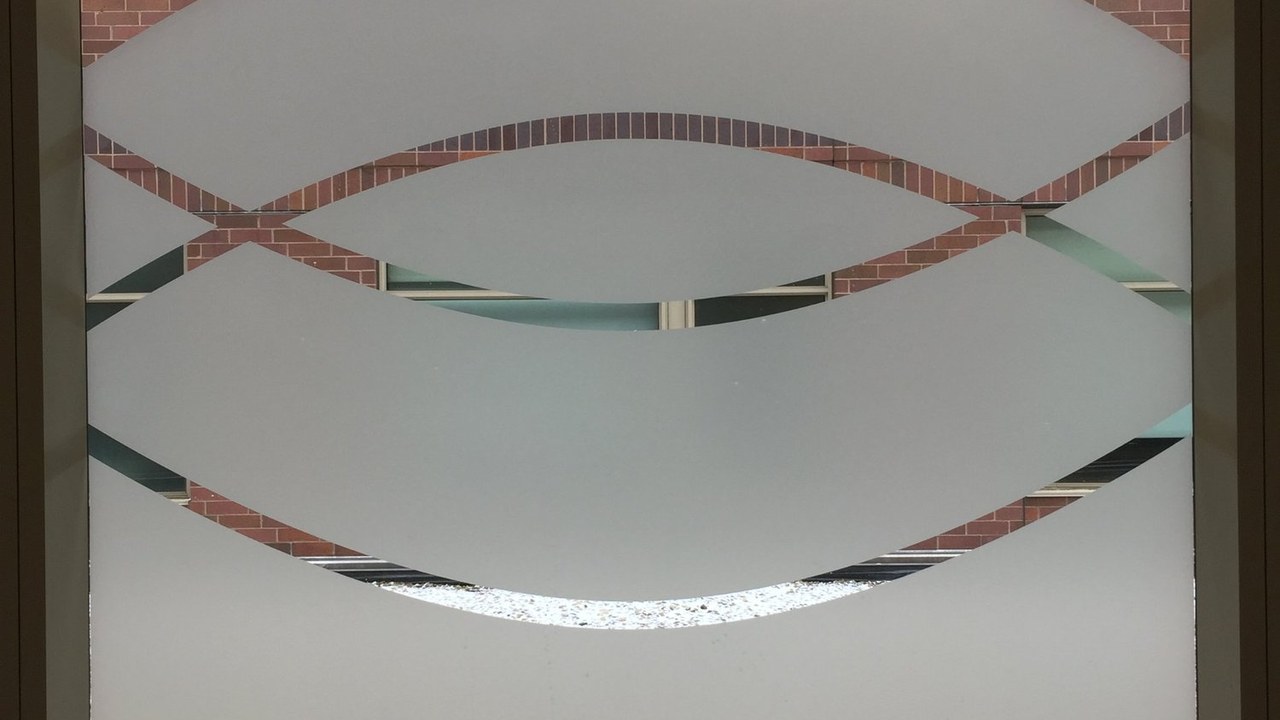
When the design matters as much as the privacy. A gradient fades from frosted to clear, so it screens where it is dense and keeps the view where it is clear. Patterns and custom designs add branding or a finished look to the glass. How much any of them hides depends on how dense the film is, where it sits on the glass and where the viewer stands.
Seeing the films on the actual glass is the best way to choose. For a library in Northern Illinois, we put up mockups of gradient and semi-opaque films from 3M, SOLYX and Solar Gard side by side before the library chose a SOLYX gradient. The project is described in our library gradient privacy film case study.
What if the concern is the screens?
Then Casper cloaking film may be the better fit. Casper, made by Designtex, is a nearly clear film that makes compatible screens look blank from outside the room while people and the room stay visible. Designtex describes it as having a tint of less than 5 percent. The film comes in 48 inch wide rolls.
It has firm limits, which is why we test it against the actual screens before installing:
- Designtex says it works with most LED displays at least 40 inches wide. That is the screen’s width, not its diagonal size. Narrower displays may cloak fully, partly or not at all.
- It does not cloak projectors, and it usually does not cloak touchscreens, phones and other small devices.
- It works best when the screen is viewed straight on, and it goes on the inside of the room with the screens.
- It hides screens, not people, whiteboards or paper. Casper can be combined with a frosted band where the room needs both.
More detail is on our Casper cloaking film page.
Does privacy film stop people from hearing a meeting?
No. Window film is visual privacy only. It does not change how much sound passes through the glass, the door or the gaps around them.
The U.S. General Services Administration’s guide to office acoustics, Sound Matters, recommends an enclosure rated at least STC 45 to separate conference rooms that need confidential speech privacy. It notes that sliding doors, which are mostly glass, generally do not have a high STC rating, and that glass pivot doors have gaps on all four sides. If a room needs to be private to the ear as well as the eye, involve an acoustical consultant, the architect or the partition manufacturer.
What about switchable glass?
Switchable glass changes from clear to frosted at the flip of a switch. It is available, but it is very expensive and is not suitable for most locations. For most conference rooms, frosted film, a band or a gradient gives the privacy needed for a small fraction of the cost and without wiring.
How do 3M, SOLYX and Solar Gard decorative films compare?
All three make frosted and decorative films, and AAA Glass Tint installs films from each. The differences that matter for a conference room are the fire rating, how much ultraviolet light the film blocks, the roll width and the warranty. Here is what the manufacturers’ documents we reviewed state.
| Item | 3M Fasara Glass Finishes | SOLYX frosted films | Solar Gard decorative films |
|---|---|---|---|
| Fire rating | All patterns Class A per ASTM E84 (interior) | Class A per ASTM E84 (Clear Frost, White Frost, gradient sheets reviewed) | ByDESIGN polyester decorative film tested to ASTM E84: flame spread 0, smoke developed 0 (Class A range) |
| Ultraviolet | Blocks at least 99% | Clear Frost transmits 14%; White Frost transmits 24% | Clear Frost blocks more than 99% (sample sheet dated 2012) |
| Roll widths | 50 inches; 60 inches for certain designs | Clear Frost 12 to 60 inches; White Frost 48 or 60 inches | Varies by product |
| Interior warranty | 5 years on interior glass for most designs, 3 for new designs; 3 years and 1 year on perimeter windows | 5 years interior; 3 years exterior for Clear Frost, 1 year for White Frost | ByDESIGN decorative: 1 to 7 years by series; some series cover replacement film only, not labor |
Two points stand out. First, 3M separates interior glass from perimeter glass, the building’s outside windows, and gives most designs a shorter warranty on perimeter glass. Film on an outside window also has to pass the manufacturer’s film to glass review, because sun on the glass raises the risk of thermal stress; we explain that in Will Window Film Crack Your Glass? Second, ultraviolet blocking varies more among frosted films than many people expect. If fading of carpet or furniture matters, check the film’s ultraviolet figure, not just its appearance. For how warranties compare across manufacturers in general, see What Does a Commercial Window Film Warranty Cover?
What conference room work have we done?
A few examples from our records:
- ALDI: 48 inch frosted bands in huddle rooms, 2026.
- Bradford Allen: SOLYX dual misty frost gradient in conference rooms, with clear frost on the sidelights and door, 2022 to 2023.
- Medical Murray: a 48 inch frosted band in the board room, and frost on the glass between a conference room and production, 2019 and 2022.
- College of DuPage: frosted film in a conference room and privacy film in counseling offices, 2024 to 2025.
- City of Naperville: frosted film on second floor doors and sidelights at the Municipal Center, 2024. See the Naperville Municipal Center case study.
For a larger privacy and decorative project, see our Advocate Sherman Hospital case study.
What is the next step?
Decide what needs to be hidden: the people, the screens, or both, and whether the room must also be private to the ear. Then look at films on the actual glass. On a free assessment we bring samples of frosted, gradient and patterned films, and Casper if screens are the concern, so you can see each one in the room before anything is ordered. Installation can be scheduled after hours or on weekends at additional cost, and we do not subcontract installation; our own crews do the work. See our privacy window film service, or request a free assessment.
Sources
- U.S. General Services Administration, Public Buildings Service, Sound Matters: How to Achieve Acoustic Comfort in the Contemporary Office (December 2011), pages 12, 26 and 33.
- Designtex, Casper Cloaking Technology resources and FAQ, reviewed October 19, 2026.
- 3M, 3M Fasara Glass Finishes Technical Data Sheet (Revision P, March 2022).
- Decorative Films, LLC (SOLYX), SX-1301 Clear Frost specification sheet (revised August 3, 2023), White Frost specification sheet (version October 24, 2025) and SXJ-0565 gradient specification sheet.
- Solar Gard (Saint-Gobain), Clear Frost sample page (SK0314SPECCFINT 02/12) and ByDESIGN Product Limited Warranty (SK0364BD 09/24).
- Commercial Testing Company for Solar Gard, ASTM E84 test report, ByDesign Polyester Decorative Film (March 8, 2021).
- AAA Glass Tint project records, 2016 to 2026.
Related resources

Privacy and Decorative
How Do You Plan Decorative Window Film for a Tenant Build-Out?
Planning decorative window film in a tenant build-out: privacy bands and logos, custom designs and approvals, how warranties compare, and what happens at lease end.
Read Article: How Do You Plan Decorative Window Film for a Tenant Build-Out?
Privacy and Decorative
What Can Window Film Do for Churches and Houses of Worship?
Where window film works in churches, synagogues and other houses of worship, why stained and leaded glass is different, and how congregations use privacy, solar and security film.
Read Article: What Can Window Film Do for Churches and Houses of Worship?
Privacy and Decorative
Window Film for Hospitals and Healthcare Facilities
How hospitals and clinics use window film for privacy, design and pharmacy security, what film does not do for compliance, and how installation works around patient care.
Read Article: Window Film for Hospitals and Healthcare Facilities
Talk to a commercial window film contractor
AAA Glass Tint has served the commercial window film market since 1984. We assess the glass, the frames and the openings before recommending anything, and we install our own work.