
Glass and Technical
How Do Low-E Coatings Affect Window Film?
A Low-E coating changes which window films are safe on the glass, what a film can add and whether glass breakage coverage applies. Its surface and number of silver layers matter most. Solar Gard approves most interior solar films with Low-E on surface 2, but few on surface 3. Clear security film is approved on every Low-E construction Solar Gard's guides cover.
How do Low-E coatings affect window film?
A Low-E coating already in the glass changes which window films can safely go on it, how much a film can add, and whether the manufacturer’s glass breakage and seal coverage applies. What matters most is which surface the coating is on. In Solar Gard’s 2026 Film-to-Glass Guide, most interior solar control films are approved on double pane glass with the coating on surface 2, but most need written approval, or are limited to tempered or heat strengthened glass, when the coating is on surface 3.
Clear safety and security films are the exception: Solar Gard approves every one of them on every Low-E construction its guides cover. For everything else, the coating has to be found and located before a film is chosen.
Key points
- Low-E coatings are invisible. Whether one is present, which surface it is on and how many silver layers it has have to be measured.
- The more silver layers in the coating, the less solar heat the glass lets in. On EDTM’s reference card, single silver double pane glass ranges from 0.49 to 0.67 SHGC and triple silver from 0.18 to 0.28, which leaves a solar film much less heat to stop.
- On double pane glass with Low-E on surface 2, Solar Gard approves 39 of its 46 interior solar control and solar safety films. With Low-E on surface 3, it approves 11.
- Solar Gard’s Low-E films are approved on Low-E surface 2 glass but limited to tempered or heat strengthened glass when the coating is on surface 3.
- Solar Gard’s exterior films are approved on every double pane Low-E surface 3 construction in its guide.
- NFRC rates retrofit window film on six reference glazing systems, none with a Low-E coating, so published film figures do not describe film on Low-E glass.
- Some caution ratings are pre-approved when the existing glass has the right solar heat gain coefficient (SHGC), so the glass’s own performance data matters.
What is a Low-E coating, and where is it in the window?
A Low-E (low emissivity) coating is a very thin coating applied to the glass when the glass is manufactured. It reflects long-wave heat and, depending on the product, can also reject a large share of the sun’s heat. Saint-Gobain, for example, rates the coated glass in its COOL-LITE XTREME 70/33 at an emissivity of 0.03 or less; ordinary clear glass is about 0.84. You cannot see it, which is why it so often goes unnoticed when a building owner asks about film.
The surfaces of an insulated glass unit are numbered from the outside in. On a double pane unit, surface 1 faces the weather, surfaces 2 and 3 face each other across the sealed airspace, and surface 4 faces the room. We explain the numbering in more detail in our window film performance terms guide.
Where the coating sits depends on what the glass was designed to do:
- Surface 2: solar control. Saint-Gobain, the parent company of Solar Gard, specifies its COOL-LITE XTREME 70/33 II solar control glass for face 2 inside the insulated unit. Saint-Gobain lists 70 percent light transmission and a 33 percent solar factor in double glazing, measured under European standards. Vitro Architectural Glass publishes its Solarban 70 the same way, on surface 2, with a solar heat gain coefficient (SHGC) of 0.27 and 64 percent visible light transmittance in a one inch double pane unit with clear glass.
- Surface 3: insulation and winter heat gain. Saint-Gobain puts the coating of its PLANITHERM NEO thermal insulation glass on face 3 of a double unit, and on faces 3 and 5 of a triple unit, with a solar factor set to let in the sun’s heat. Vitro designed its Sungate 400 for heating-dominated climates and says it performs best as a third-surface coating, where it helps a building collect the sun’s heat and hold on to heat in winter.
- Surface 4: room side. Some durable pyrolytic (hard coat) Low-E coatings can face the room. Vitro’s technical document on its pyrolytic coatings covers coatings exposed to the building interior and notes that they lower the indoor glass temperature in winter. Solar Gard’s guide has no rating column for a coating on surface 4. When we find one, we follow Solar Gard’s film to glass guidance and explain to the customer what can happen before any film covers it.
Why does the coating’s surface matter for window film?
Because it changes where the sun’s energy ends up once a film is added. The International Window Film Association says whether film should be used on Low-E windows, and how much it will help, depends on the type of Low-E surface, where that surface sits in the window system, and what the owner wants the film to do. The European Window Film Association lists glass coatings among the factors that decide film to glass compatibility, and warns that performance figures for one glazing system can be misleading when applied to another.
The risk Solar Gard is managing is thermal stress and seal failure. Its guide explains that a Low-E Caution rating means a film may not be eligible for glass breakage and seal failure coverage, because the risk is higher when that film goes on a double pane unit with a Low-E coating. The guide does not give the engineering reason for each rating. The general principle is the one behind all thermal stress: the more solar energy an inner pane absorbs, the hotter it runs, and a coating on surface 3 sits on that same inner pane. We explain how thermal stress works in Will Window Film Crack Your Glass?
Does it matter whether the Low-E is single, double or triple silver?
Yes, as much as the surface does. Sputtered (soft coat) Low-E coatings are built from very thin layers of silver, and the number of silver layers sets how much of the sun’s heat the glass already blocks before any film goes on. More silver means a lower solar heat gain coefficient and more daylight for each unit of heat let in.
EDTM, the maker of the glass meter we carry on every survey, publishes a reference card of common commercial Low-E products grouped by silver count. Its figures are center of glass values calculated with Lawrence Berkeley National Laboratory’s WINDOW software under NFRC conditions, for double pane units of 1/8 inch glass with the coating on surface 2:
| Coating | SHGC | Visible light transmitted | UV transmitted | Examples on the card |
|---|---|---|---|---|
| No coating (clear) | 0.77 | 81% | 58% | Clear glass |
| Hard coat (pyrolytic) | 0.47 to 0.70 | 55% to 77% | 41% to 50% | Pilkington Energy Advantage, Pilkington Solar E |
| Single silver | 0.49 to 0.67 | 75% to 80% | 17% to 44% | Vitro Sungate 400, Cardinal LoE-180 |
| Double silver | 0.26 to 0.47 | 40% to 72% | 13% to 26% | Vitro Solarban 60, Cardinal LoE-270 |
| Triple silver | 0.18 to 0.28 | 39% to 65% | 2% to 11% | Vitro Solarban 70XL, Cardinal LoE-366 |
| Quad silver | 0.23 | 52% | 1% to 8% | Vitro Solarban 90, Cardinal LoE-452+ |
A glass coatings lecture from Lehigh University’s International Materials Institute, which credits engineers at PPG Industries, shows the same pattern for a single product family: each added silver layer lowers SHGC and raises the ratio of daylight to solar heat. Hard coat Low-E is a different technology, and EDTM’s meter reports it separately from the sputtered silver coatings.
The silver count changes the film decision in four ways:
- How much heat is left to stop. A triple silver unit already holds solar heat gain to about 0.18 to 0.28. A solar film has far less to remove than it would on single silver, hard coat or uncoated glass, so the improvement in heat can be modest.
- Glare and light are a different question. Most coated units on the card still transmit well over half the visible light. Glare, brightness and privacy complaints remain on every silver count, and on high performance Low-E they are often the real reason film goes on. UV is the reverse: triple and quad silver units already let through 11 percent or less of UV, so UV protection adds little there.
- Which side the film goes on. The coating, its surface and the complaint all feed into whether an interior film, an exterior film or a film to glass application is the right path, along with access, logistics, the time of year and budget.
- Whether a caution film is pre-approved. Solar Gard’s SHGC rules track the coating’s performance. On EDTM’s card, every double, triple and quad silver product is below the 0.58 that pre-approves an exterior caution film on surface 2 Low-E glass, while most single silver and hard coat products are above it. These are center of glass figures; the SHGC of the actual unit is what Solar Gard’s rule uses, and the NFRC section below explains why the two differ.
There is no standard film for each silver count, and AAA Glass Tint does not use one. We look at the glass, the customer’s main concern and which films are compatible with that glazing, then weigh installation difficulty, building access, project logistics, the time of year and budget. When more evaluation is needed, Solar Gard Technical Services can calculate how a specific film is expected to perform on a particular glazing configuration using NFRC data.
Keep two questions apart. Compatibility asks whether a film is approved for the glass. Performance asks how much it will actually change heat, glare or light on that glass. A film can calculate well and still need written approval before it goes on, and an approved film can make only a modest difference on high performance Low-E glass.
Which window films are approved on Low-E glass?
The table below counts how Solar Gard rates its films on Low-E glass in its current Film-to-Glass Guide (PDF0234 02/26) and Triple Pane Film-to-Glass Guide (PDF0234TR 02/26). “Approved” means pre-approved. “Caution” means a film to glass application and Solar Gard’s written approval are required. “Tempered or HS only” means the film is approved only where every pane is tempered or heat strengthened.
| Film family (number of films) | Double pane, Low-E on surface 2 | Double pane, Low-E on surface 3 | Triple pane, Low-E on surface 2 |
|---|---|---|---|
| Clear safety and security (6) | All approved | All approved | All approved |
| Interior solar control and solar safety (46) | 39 approved, 7 caution | 11 approved, 28 caution, 7 tempered or HS only | 1 approved, 41 caution, 4 tempered or HS only |
| Low-E films: Ecolux 70, Silver AG 50 and AG 25 Low-E (3) | All approved | All tempered or HS only | All caution |
| Exterior, outside weatherable (13) | 10 approved, 3 caution | All approved | 10 approved, 3 caution |
| Anti-graffiti, Graffitigard (3) | All approved | All approved | All approved |
Two patterns stand out. Interior solar films are far more restricted when the coating is on surface 3, and the more panes and coatings a unit has, the fewer films are pre-approved. On triple pane glass with Low-E on surface 2, Sterling 70 is the only interior solar control film Solar Gard approves outright. Solar Gard’s triple pane guide rates Low-E only on surface 2 and on surfaces 2 and 5. A triple unit coated elsewhere, such as Saint-Gobain’s faces 3 and 5, is not in the table, and the guide’s direction for any combination it does not cover is a film to glass application. These counts come from one manufacturer’s guide; other manufacturers publish their own, and their ratings differ.
What do the SHGC rules in the guide mean?
Some caution ratings carry a note that turns them into pre-approvals when the existing glass meets a solar heat gain coefficient (SHGC) limit. In Solar Gard’s guides:
- An exterior caution film on double pane glass with Low-E on surface 2 is pre-approved when the unit’s SHGC is 0.58 or greater.
- An interior caution film on double pane glass with Low-E on surface 3 is pre-approved when the unit’s SHGC is 0.61 or less.
- An interior caution film on triple pane glass is pre-approved when the unit’s SHGC is 0.41 or less with Low-E on surface 2, or 0.33 or less with Low-E on surfaces 2 and 5.
That means the same coating can lead to different answers. Vitro publishes Sungate 400 on surface 3 at an SHGC of 0.73 when both panes are its low-iron Starphire glass, and at 0.44 when the outer pane is its tinted Solexia glass. Under Solar Gard’s rule, an interior caution film would need a written application on the first unit, but would be pre-approved on the second. Knowing the glass’s actual SHGC, from the building’s glazing submittals or the glass manufacturer’s data, can settle the question before an application is needed.
Does window film still help if the glass already has Low-E?
Often, but usually less for heat than people expect, and it depends on the complaint. A solar control Low-E unit like the Solarban 70 example above already holds the sun’s heat to an SHGC of 0.27, so a solar film has much less heat left to stop. Window film performance data is published for film on specific glass, usually clear glass, and those figures do not carry over to a unit that already has a Low-E coating. For a specific Low-E unit, Solar Gard Technical Services can calculate a film’s expected performance using NFRC data.
The U.S. General Services Administration reached the same conclusion for Low-E film. In its 2017 Green Proving Ground study, it recommended room-side Low-E film for single pane windows and for double pane units without a Low-E coating between the panes, which is where the film has the most room to improve. We compare Low-E film with new windows in Low-E Window Film vs. Window Replacement.
Other complaints are not solved by the coating at all. A Low-E unit that transmits 64 percent of visible light can still cause glare. Low-E glass gives no daytime privacy and does not hold broken glass together. Glare control, privacy, decorative and security films are often the reason film goes on Low-E glass, and clear security film is approved on every Low-E construction in Solar Gard’s guides.
What do NFRC ratings tell you about film on Low-E glass?
They tell you a lot about the window and the film separately, and less about the two together. The National Fenestration Rating Council (NFRC) runs the voluntary U.S. program that rates and labels windows, doors and skylights, and its procedures also cover applied window film. Its standard for solar heat gain, ANSI/NFRC 200-2023, defines SHGC as the ratio of the solar heat gain entering the space through the product to the solar radiation striking it, counting both the energy transmitted directly and the energy absorbed and then released inside.
Three points from NFRC and Lawrence Berkeley National Laboratory matter for film on Low-E glass:
- Whole window and center of glass are different numbers. NFRC 200 calculates a product’s SHGC by combining the center of the glass with the edge of the glass and the frame, weighted by area. The EDTM and Vitro figures in this article are center of glass values, so they will not match a whole window rating for the same glass.
- The glass data is shared. NFRC’s rating system runs on LBNL’s WINDOW software, which draws its glass data from LBNL’s International Glazing Database. That database includes coated glass and applied films on glass. For commercial buildings, NFRC’s Component Modeling Approach builds whole product ratings from component data, with the glazing data taken from the same database.
- Film ratings are on reference glass, not Low-E glass. NFRC 200 rates a retrofit film on six reference glazing systems: single and double pane units of clear or grey glass. None of them has a Low-E coating. A film’s NFRC or data sheet figures describe it on that kind of glass, not on the coated unit in your building, which is why a calculation for the actual glazing configuration is worth asking for.
Solar Gard’s own data sheets follow the same approach: their performance results are calculated using NFRC methodology and LBNL WINDOW software, on the clear glass named on each sheet. NFRC’s Certified Products Directory for applied film lists 37 films under Saint-Gobain Solar Gard LLC, each with its own certification number. They include interior solar films such as Sterling, Slate, Silver, TrueVue and Panorama Hilite, the Ecolux 70 Low-E film, and exterior Sentinel Plus films. Slate 20, for example, is SGF-K-013, Hilite 70 is SGF-K-063 and Ecolux 70 is SGF-K-049.
When is exterior film the better choice on Low-E glass?
When the coating is on surface 3 and the goal is solar control. Every outside weatherable film in Solar Gard’s guide is approved on double pane glass with Low-E on surface 3, while most interior solar films are not. Exterior film stops the sun’s energy at surface 1, before it reaches the coated inner pane. On one recent project, a meeting space needed glare reduction and the glass had a Low-E coating on surface 3, so our crew installed the film on the outside of the glass.
Exterior film is a different product with different tradeoffs. It is made to withstand weather, we seal its edges, and the work is done from outside the building, which can mean lifts. On surface 2 Low-E glass, three of Solar Gard’s thirteen exterior films carry a caution. Our PPG exterior film case study shows an exterior installation on double pane glass. In Northern Illinois, exterior installation is generally not practical in winter, so the season can decide the timing, or the approach.
How do you find out whether your glass has a Low-E coating?
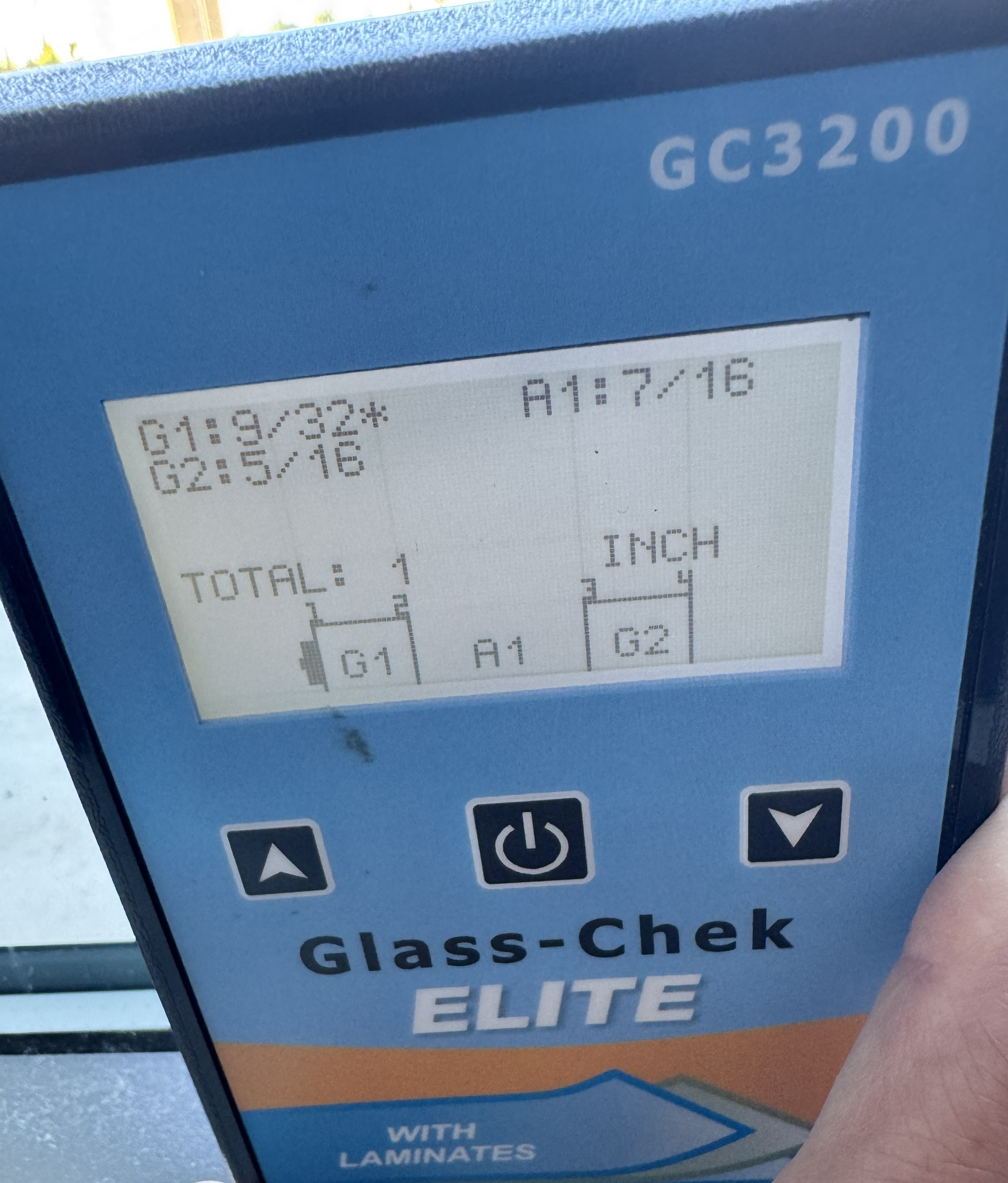
You measure it. AAA Glass Tint carries an EDTM Glass-Chek ELITE on every survey. EDTM’s operating manual states that the meter determines the presence, location and type of Low-E coatings, along with glass and airspace thickness, from one side of the window. It reports whether the coating is hard coat or soft coat and, for soft coats, whether it is single, double or triple silver. The manual also notes its limits: some readings cannot tell whether a coating is on surface 3 or surface 4, on triple pane units the meter only checks the first two panes for coatings, and when a window has more than one Low-E coating the meter identifies only the nearest one. In both cases EDTM directs the user to test again from the other side of the glass.
Building records can help. Glazing submittals, shop drawings and the glass manufacturer’s data sheets may name the coating, the surface and the SHGC, which is the number the SHGC rules above depend on. Records are not always available or current, though, and in our experience the meter is the most reliable way to verify what is actually in the frame.
What happens if the film you want is not approved for your glass?
The installer submits a film to glass application to Solar Gard Technical Services, with every pane’s strength, thickness and coating. Solar Gard also requires an application and written approval for any installation over 2,500 square feet, whatever the glass. If the combination is approved, the work can proceed with glass breakage and seal coverage. Applications are sometimes declined. When that happens, a different film, an exterior film, or no film at all is the honest answer.
AAA Glass Tint’s standard is to recommend films that are already approved for the glass in front of us. If a customer wants a film that needs approval, we complete the application and wait for Solar Gard’s answer before installing anything. If it is not approved, we recommend something else. If the customer still wants that film, we do not proceed unless the customer signs a waiver, and we state clearly in writing what can happen. A waiver is not manufacturer approval, and it does not restore Solar Gard’s glass breakage or seal coverage.
What should you ask before film goes on Low-E glass?
Ask whether the installer has confirmed if there is a Low-E coating and which surface it is on, whether the proposed film is approved for that exact construction in the manufacturer’s current guide, and, if it carries a caution, whether the SHGC rule applies or an application has been approved in writing. Then ask what the film will actually add on top of the coating for your complaint. If a contractor cannot answer those questions, the glass has not been surveyed. Request a free assessment from AAA Glass Tint.
Sources
- National Fenestration Rating Council, ANSI/NFRC 200-2023, Procedure for Determining Fenestration Product Solar Heat Gain Coefficient and Visible Transmittance at Normal Incidence, sections 3, 4 and 5.7.
- National Fenestration Rating Council, The Facts about the Component Modeling Approach (CMA).
- U.S. Department of Energy, Energy Performance Ratings for Windows, Doors, and Skylights.
- National Fenestration Rating Council, Certified Products Directory, applied film, Saint-Gobain Solar Gard LLC, reviewed October 11, 2026.
- Lawrence Berkeley National Laboratory, International Glazing Database (IGDB), Windows and Daylighting Group.
- Solar Gard, Film-to-Glass Guide, PDF0234 02/26.
- Solar Gard, Triple Pane Film-to-Glass Guide, PDF0234TR 02/26.
- Solar Gard, Film-to-Glass Application, SK0322.
- International Window Film Association, Frequently Asked Questions, “Can window film be installed on low-e windows?”
- European Window Film Association, Thermal Stress: Film-to-Glass Compatibility, published via glassonweb.com.
- Saint-Gobain Glass UK, COOL-LITE XTREME 70/33 and 70/33 II, highly selective solar control coated glass, document 39, 05/26.
- Saint-Gobain Glass UK, PLANITHERM NEO, product page, reviewed October 2026.
- Vitro Architectural Glass, Solarban 70 Glass product data sheet, 7097, 04/22.
- D. J. O’Shaughnessy, Physical Vapor Deposition of Coatings on Glass, Lecture 12, Glass Processing course, International Materials Institute, Lehigh University.
- Vitro Architectural Glass, Sungate 400 Passive Low-E Glass, product page, reviewed October 2026.
- Vitro Architectural Glass, Glass Technical Document TD-108, Pyrolytic Low-E Coated Glasses: Commercial Design Considerations, revision 4, 2016.
- U.S. General Services Administration, Green Proving Ground, GPG-032, room-side low-e window film, 2017.
- EDTM, Low-E Coatings Table and glass performance reference card (center of glass values calculated with LBNL WINDOW 7.8.77.0 and NFRC 100-2010 conditions), copy dated June 2026.
- EDTM, Glass-Chek ELITE GC3200 Operating Manual.
Related resources
Glass and Technical
Will Window Film Crack Your Glass?
Window film rarely cracks glass when it is matched to the glass. Where the risk actually comes from, how compatibility is checked, and how to tell what broke a pane.
Talk to a commercial window film contractor
AAA Glass Tint has served the commercial window film market since 1984. We assess the glass, the frames and the openings before recommending anything, and we install our own work.