
Security Window Film for Illinois Video Gaming Locations

Our servicesSafety and security filmVideo gaming security film

We install security film on the entrance doors and storefront glass of Illinois video gaming locations: gaming cafes, bars and restaurants with terminals, truck stops and convenience stores. The film holds broken glass together. Attached to the frame with structural silicone, it helps keep a broken door or window in the opening longer, which can help delay forced entry.

Several locations, or a terminal operator’s program? Discuss a multi-location security film program. We typically respond within one business day.

  • 50+ Illinois video gaming locations
  • Commercial window film since 1984
  • Armorcoat Certified Partner
  • Our own crews, no subcontracting
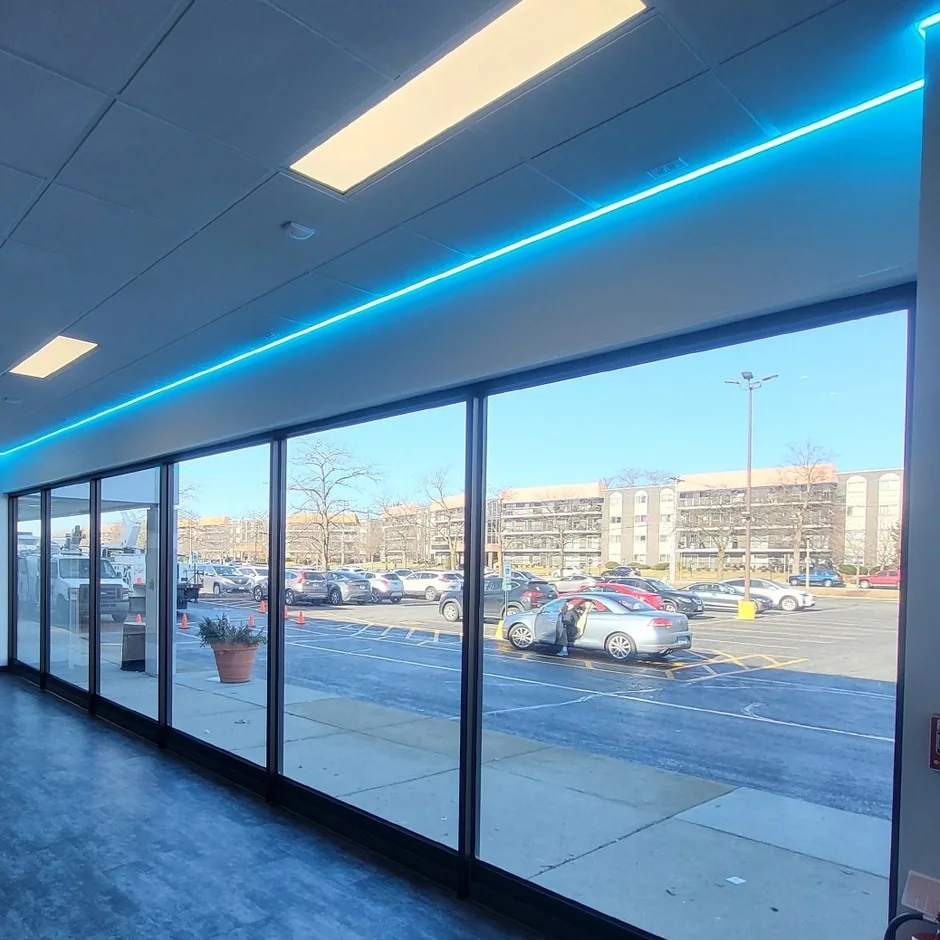
A storefront’s glass wall and doors seen from inside, with a parking lot and an apartment building outside and a blue light strip along the ceiling.
Security window film on storefront glass, seen from inside after the installation.

What gaming locations face

Break-ins at Illinois video gaming locations, counted

The Illinois Gaming Board keeps the count. These are the Board’s figures, released to and reported by the Chicago Sun-Times on June 30, 2026.

2024

358 burglaries of video gaming establishments; about 1.9 million dollars taken.

2025

473 burglaries; more than 2.7 million dollars taken.

2026, to June 22

502 burglaries, already more than in all of 2025. By June 16, more than 1.5 million dollars taken, including nearly 50 break-ins of 10,000 dollars or more.

Where

More than 100 municipalities. The most in Cicero (more than two dozen), Berwyn (about 20) and Blue Island (16).

How it happens. A crew arrives at night when the location is closed, sometimes in a stolen car, smashes through the front door or a window, takes crowbars and sledgehammers to the terminals, the ATM and the redemption kiosk, and is in and out in minutes (Chicago Sun-Times, June 30, 2026; CBS Chicago, June 10, 2026). Suburban police formed a task force in February 2026 (CBS Chicago, June 10, 2026; Daily Herald, September 10, 2026).

Where the glass comes in. Many of these break-ins involve forced entry through a door or a window. Film and the attachment do not change the alarm, the cameras or the cash on hand. They change how long the glass stays in the opening. Beyond the glass, a break-in means terminals offline, an unsecured space until board-up, lost operating time and the report the Board requires under rule 1800.270.

What the Gaming Board says

It is not a first responder, and licensees “play a critical role in protecting their own property” (Sun-Times, June 30, 2026).

At its June 11, 2026 meeting the Gaming Board’s Administrator said the Board takes these burglaries very seriously, encourages proactive measures as deterrents, and urged operators to use all the security measures available to them (reported by Fox Rothschild, At Stake, June 11, 2026).

Sources: Chicago Sun-Times, June 30, 2026 (Illinois Gaming Board records); CBS Chicago, June 10, 2026; Daily Herald, September 10, 2026; Illinois Gaming Board memorandum, January 13, 2026; Fox Rothschild, At Stake 88, June 11, 2026. Illinois had 8,861 licensed video gaming locations and 49,450 terminals at the end of 2025 (Illinois Gaming Board, 2025 Annual Report).
At the glass

What film and the attachment change when the glass breaks

A crew wants the door open in a few swings. Film and the attachment make the glass take longer to clear; they do not stop it from breaking.

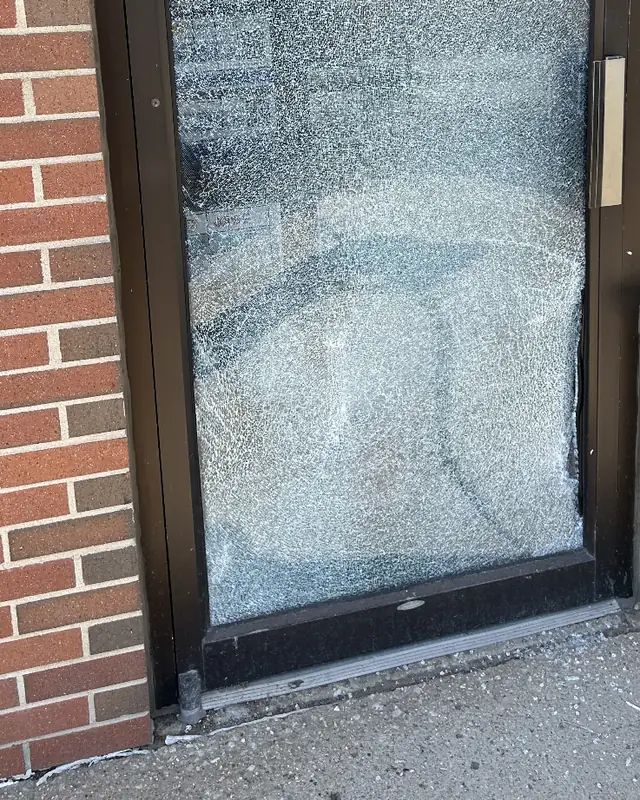
A glass storefront door in a brick wall, its glass broken into small pieces that remain in the door frame.
A storefront door after an attempted break-in. The glass shattered but remained in the opening. AAA Glass Tint had installed 8 mil security film, attached to the frame with DOWSIL 995 structural silicone. This is a different incident from the customer-reported incident described in the box on this page.
  1. 01

    Tempered door glass shatters all at once

    The glass in commercial entrance doors and sidelights is usually tempered. When it breaks, it breaks into small pieces all at once, and without film the pieces can fall away from the opening.

  2. 02

    The film holds the pieces as one sheet

    Security film is bonded to the inside face of the glass. When the glass breaks, the film holds the pieces together.

  3. 03

    The attachment helps keep the sheet in the frame

    A continuous bead of structural silicone joins the filmed glass to the frame on all four sides, so the broken sheet does not simply fall or get pushed out, and getting through takes repeated work. The system is passive: no power, no fluid, no one on duty. Once installed, it is part of the glass.

Reported by a customer. One example from our own work: at an Illinois video gaming location where we installed 8 mil clear Armorcoat with a four-sided DOWSIL 995 attachment, the customer’s security director reported that intruders struck a glass door 18 times with a sledgehammer before getting in. That was reported by the customer, not a laboratory test or a guarantee of performance. Results vary with the glass, the frame, the attachment and the attempted entry. It shows what the system is meant to do: the glass broke, and the opening still took real work.

How film and the attachment work against a smash-and-grab

No film makes glass impossible to break through. The goal is to make an opening take longer to create. Security film is not bullet resistant: Solar Gard states that Armorcoat does not meet UL 752, the bullet resistance standard, or UL 972, the standard for burglary resistant glazing. Film does not strengthen the door’s lock, hinges or frame. What security window film can and cannot do

Our gaming work

Security film at more than 50 Illinois video gaming locations

Gaming cafes, bars and restaurants with terminals, truck stops and convenience stores, for individual owners and for operators with many locations. We keep our gaming customers’ names private.

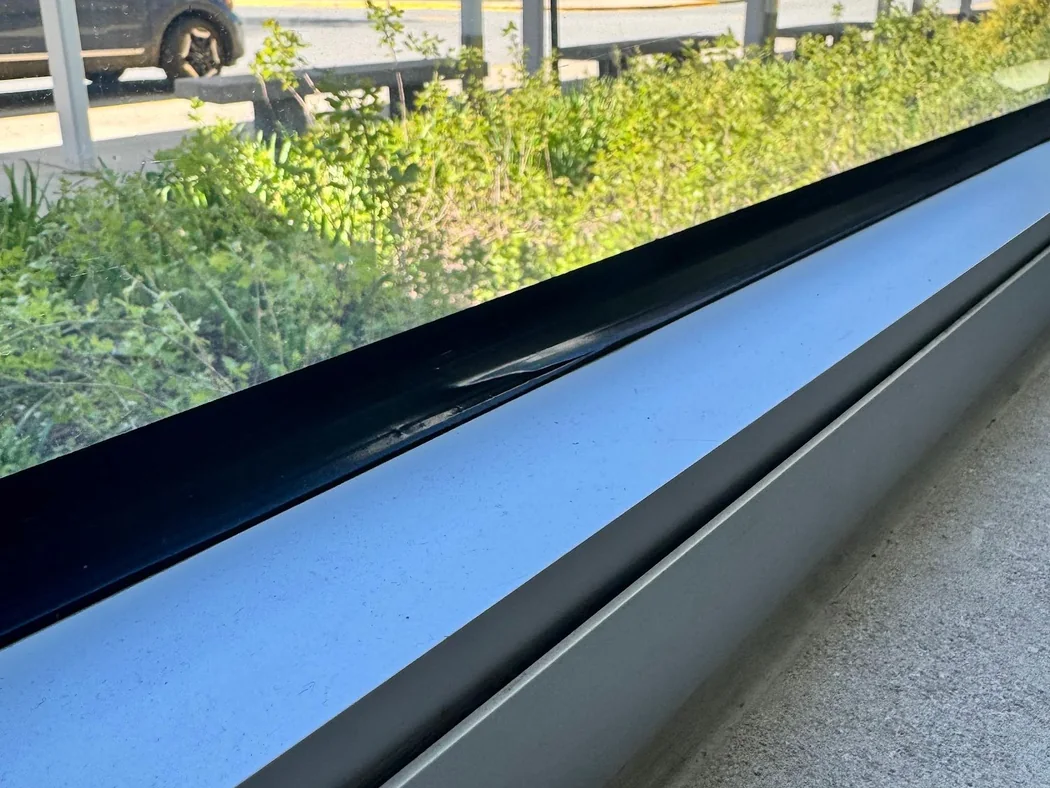
Looking along a window sill from inside: a black silicone bead joins the glass to a white frame, with shrubs, a parked car and a canopy outside.
The attachment, seen from inside: a continuous bead of structural silicone joins the filmed glass to the frame.

What we install at a gaming entrance

8 mil clear Armorcoat, attached on all four sides

Sized to the glass, the frame and the opening. Locations differ, so not every one gets an identical system.

  • GlassEach opening inspected for glass identification markings and measured with our Glass-Chek meter: thickness, air spaces, Low-E coatings and laminated construction
  • ApprovalEvery film checked against the manufacturer’s film-to-glass guidance, with written approval when the glass requires it
  • Clear filmSolar Gard Armorcoat clear, 8 mil as standard, 14 mil where an opening carries more risk; as an Armorcoat Certified Partner, AAA Glass Tint installs Armorcoat thicker than 8 mil
  • Tinted filmSolar Gard Armorcoat Stainless Steel 35 or Silver 20, 8 mil, where a location also wants less glare and heat by day, or the gaming area less visible from outside (the rules below come first)
  • AttachmentDOWSIL 995 structural silicone on all four sides, in black or white to suit the frame
  • DoorsHardware, stops and clearances decide the attachment, so doors take more attention than fixed glass
  • FramesIf a frame cannot support a proper attachment, we say so plainly: film alone still holds broken glass together, but we do not present it as a forced-entry delay system

Security Film Attachment Systems Explained

One location

Individual gaming establishments

A free on-site assessment of the glass, frames and doors; a system for each opening, or a plain statement when film is the wrong answer; installation around your hours, usually a day for an entrance.

Request a Commercial Assessment

Many locations

Multi-location programs and terminal operators

Most of our gaming installations were commissioned by terminal operators as multi-site rollouts: one assessment at each site, the same film and attachment wherever the glass and frames allow, one schedule, and the documents each landlord and operator asks for.

Discuss a multi-location program

One layer among several

Where film fits in a gaming location’s security plan

Police, villages and terminal operators are all recommending measures. Each does a different job, and most begin working after the glass is already broken. AAA Glass Tint installs window film systems and none of the others; this is how they fit together.

Cameras and alarms

Required cameras (rule 1800.250, provided by the terminal operator) and alarms record or report the break-in; the police arrive after it has begun.

Drop-down shutters and metal shields

Cover the glass when someone lowers them, usually after closing, and change the look of the storefront; some locations are adding them. Film works at any hour, including when the shutter is up.

Security fog

Fills the room after entry, on the alarm’s signal, with power and fluid; it acts inside the building, while film acts at the glass, before entry.

Doors, frames, locks, anchored machines and less cash

A sound frame is what the attachment holds to, and the lock and hinges are what film does not strengthen; anchored machines, enclosures and less cash overnight change what a crew can take once inside.

Security film with the attachment

A passive layer on the glass itself, with no power, no fluid and no one on duty: it holds broken glass together and helps keep it in the frame longer. It is not a substitute for any measure above, and where a location needs rated forced-entry or bullet-resistant glazing, we say so and point to it.

The rules that touch the glass

  • Does Illinois require security film at gaming locations? No. The Gaming Board’s rules require a secure premises and a prompt report to the terminal operator and the Board’s Administrator after any unlawful entry that affects the terminals (11 Ill. Adm. Code 1800.270), an owner, manager or employee over 21 present with the terminals or the entrance to the gaming area in view (1800.810), and the operator’s cameras on the gaming area, kept at least 30 days (1800.250). None names window film, and film does not by itself satisfy any of them.
  • Can film affect the visibility or surveillance the rules require? Clear security film leaves the view unchanged in both directions; it does not by itself satisfy any rule. Tinted or opaque film needs checking against the employee’s view, the cameras and the village code: Downers Grove requires that terminals not be visible from the exterior and that the gaming room’s walls be solid, not glass (Ordinance 2023-10057, Sec. 3.607, effective January 1, 2024), so there film is not the answer, and some liquor codes regulate window coverings. Check your village before choosing any tint.
  • Can a terminal operator pay for it? Rule 1800.350(b)(3), added March 8, 2021, lets a terminal operator provide “video surveillance, alarms, ID scanners, or other security systems or devices required by this Part or intended to monitor or enhance the security and integrity of video gaming operations and the video gaming area”; surveillance and alarms may cover exterior entrances and exits; where a system covers gaming and non-gaming areas, only the gaming share may be provided; and the rule excludes “the costs of permanent physical construction.” Neither the rule nor the Board’s memorandum of January 13, 2026 mentions window film. Whether an operator may pay for a film system at your location, in whole or by cost-sharing, is a question for your operator and the Board’s legal staff.

We are a window film contractor, not a law firm. The rules are quoted for orientation and linked to their official texts: 1800.270, 1800.810, 1800.250, 1800.350, the Board’s memorandum of January 13, 2026, Downers Grove Ordinance 2023-10057. Your terminal operator, your village and the Board decide how they apply to your location.

Installation and cost

Installed around your hours, at one location or many

Film goes on the inside of the glass. We work before you open, after you close or on a weekend, and the location keeps operating.

Around your hours

Scheduled around the location’s operating hours. After-hours and weekend installation is available at additional cost.

An entrance in a day

A typical entrance with a pair of doors and sidelights can often be done in one working day. The silicone keeps curing after we leave: Dow lists 7 to 14 days to cure and 14 to 21 days to full adhesion at 77 degrees Fahrenheit and 50 percent relative humidity; cold or dry weather slows it.

Several locations

Most of our gaming installations were commissioned by terminal operators as multi-site rollouts: one assessment at each site, the same film and attachment wherever the glass and frames allow, one schedule, and the documents each landlord and operator asks for. We work with the location’s owner or manager, the company behind several locations or the operator’s security staff; the quote and the manufacturer’s warranty go to the purchasing company, and the commercial warranty is not transferable.

Paperwork

Certificates of insurance and additional insured forms, W-9s, and manufacturer data sheets for landlords and operators. We register the manufacturer’s film warranty and send the warranty information by email.

After a break-in

The film and the attachment come out with the broken glass. Once the glazier has replaced the glass, we install new film and a new attachment on it, so plan for it in any glass repair.

What it costs. As of October 2026, a typical gaming entrance, a pair of doors with sidelights in 8 mil clear Armorcoat with the four-sided attachment, generally falls in the low thousands of dollars. The glass, the film thickness, the length of the attachment, the number of openings, access and after-hours work move the price, and a minimum project charge applies.

What commercial window film costs

Want a price for your location? Request a Commercial Assessment

We do not subcontract installation; our own crews do the work. David Johnson, the owner, or one of our field technicians assesses every location before we recommend anything.

Credentials

Armorcoat Certified Partner

Solar Gard authorized dealer for more than 20 years

Member of the International Window Film Association (IWFA)

Rated A+ by the Better Business Bureau

Questions

Questions gaming owners and operators ask

Crews are getting in with sledgehammers in minutes. What does film actually change?

The glass. Film holds the broken glass together and the attachment helps keep it in the frame, so a door or window does not clear in a few swings; the crew has to keep working, in the open. At one Illinois gaming location, the customer reported 18 sledgehammer strikes on a filmed door before entry. With enough time and tools a crew can still get in: no film makes glass impossible to break through.

Does security film affect our compliance with Gaming Board rules?

Clear film does not change what an employee or a camera sees, so the view requirement of rule 1800.810 and the camera requirement of rule 1800.250 are unaffected. No Gaming Board rule requires security film, and film does not satisfy any rule by itself. A tinted or opaque film is a different question: check your village’s code and the employee’s view before choosing one.

Our village wants the terminals hidden from the street. Can film do that?

Sometimes. Where the code requires only that the terminals not be visible from outside, an opaque or heavily tinted film on the gaming-area glass can be one way to comply, as long as an employee inside keeps the view the Gaming Board requires. Where the code requires solid walls, as in Downers Grove, film is not the answer. We tell you which case you are in before we quote.

Should we get fog or shutters instead of film?

They do different jobs, and they stack. Shutters cover the glass when they are down; fog fills the room after someone is inside; film works at the glass itself, at any hour, with no power and no one on duty. Many owners use more than one. We install film only, and we will say so if what you need most is something else.

Can you do all of our locations, and work with our terminal operator?

Yes. Most of our gaming installations were commissioned by terminal operators as multi-site rollouts, and we work with whoever is buying: the location, the company behind it or the operator. Who pays is between the location and its operator. Rule 1800.350(b)(3) lets an operator provide “video surveillance, alarms, ID scanners, or other security systems or devices required by this Part or intended to monitor or enhance the security and integrity of video gaming operations and the video gaming area,” but not permanent physical construction. Neither the rule nor the Board’s memorandum of January 13, 2026 mentions window film. Whether an operator may pay for a film system at your location, in whole or by cost-sharing, is a question for your operator and the Board’s legal staff.

Can the film be tinted so people cannot see in by day?

Yes, within the rules above. We have installed both clear and tinted security film at gaming locations. Solar Gard makes Armorcoat in Stainless Steel 35 and Silver 20, 8 mil security films with a reflective tint that cuts the daytime view in and also reduces glare and heat. At night, with the lights on inside, a tinted film does not hide the room; only an opaque film does. Clear film leaves every view and every camera unchanged. Does privacy window film work at night?

What happens after a break-in?

The film and the attachment come out with the broken glass. The glazier or board-up company replaces the glass, and we install new film and a new attachment on it. The location also reports the entry to its terminal operator and to the Board’s Administrator, as rule 1800.270 requires.

Two ways to start

One location, or a program across many

A single gaming location

Request a free on-site assessment. David Johnson, the owner, or one of our field technicians looks at the glass, the frames and the doors, and recommends a system for each opening, or says plainly when film is the wrong answer.

Several locations, or a terminal operator’s program

Tell us how many locations, where they are and what you know about the glass, and we will propose a program: one assessment at each location, one system, one schedule, and the documents each landlord asks for. Use the request form and mention the number of locations.

Discuss a multi-location program

AAA Glass Tint is a commercial window film contractor serving commercial buildings throughout Northern Illinois since 1984. A family-owned company headquartered in Elgin, Illinois, with field crews based in Chicago, Northbrook, Wheaton and Orland Park.

Or call 815-216-4203, Monday through Friday, 8 AM to 5 PM. We typically respond within one business day.

×