
Planning and Procurement
How to Compare Commercial Window Film Bids
Commercial window film bids usually differ because they are not for the same job: one may miss glass, price a different film, leave out removal, access equipment, the attachment system or prevailing wage. Before comparing prices, confirm that every contractor is bidding the same system, on the same glass, with the same scope.
Why do commercial window film bids come in so far apart?
Usually because the bids are not for the same job. One contractor may have missed some of the glass, priced a different film, left out removal of old film, skipped the lift or the attachment system, or bid without prevailing wage. Sometimes the measurements are simply wrong. Before comparing the bottom line, find out exactly what each contractor included.
Key points
- Most gaps between bids come from scope, not price: missed glass, a different film, old film removal, access equipment, the attachment system or prevailing wage.
- A bid should name the manufacturer and exact product, the glass covered, quantities, removal, attachment, access, warranty and exclusions.
- A security film bid without an attachment is a different system, not a discount.
- Solar Gard’s film to glass guide requires written approval for any installation over 2,500 square feet and for round, bent or laminated glass.
- On Illinois public works, the Prevailing Wage Act (820 ILCS 130) requires certified payroll to be filed monthly.
- IWFA says ASTM F3561 is not appropriate in a bid specification or submittal for retrofit film.
The useful question is not which bid is cheapest. It is whether the contractors are bidding the same system, on the same glass, with the same scope. Once that is true, comparing price is straightforward. For broad project ranges and the factors that move them, see what commercial window film costs and what moves the price.
What should a commercial window film bid spell out?
A good bid makes the scope obvious. You should not have to guess what you are buying. At a minimum it should identify:
- The film manufacturer and the specific product name, not just a category such as “security film” or “solar film”
- Which glass is being covered, by location or elevation
- Approximate quantities, in panes and square feet
- Whether existing film is being removed
- The attachment system, when the work is security film
- Access equipment, such as lifts or swing stages
- Cleanup
- The warranty that applies
- Important exclusions, stated plainly rather than buried
The product name matters more than buyers expect. Films that sound alike can differ in thickness, performance and which glass they are approved for, and some product lines are sold only through authorized dealers. Solar Gard’s film to glass guide, for example, notes that its Panorama films are available only through authorized Panorama dealers.
Line those items up side by side and most of the gap between bids usually explains itself.
| Scope item | What to check in each bid | Why it changes the price |
|---|---|---|
| Film | Manufacturer and exact product named | Products differ in cost, performance and glass approval |
| Glass covered | Same openings, same quantities | Missed glass makes a bid look cheaper than the job |
| Removal | Old film removal included or excluded | Removal is real labor, and it is easy to leave out |
| Attachment | Type of attachment to the frame, for security film | Film without attachment is a different, cheaper system |
| Access | Lifts, swing stages, after hours work | Equipment and scheduling are often the hidden cost |
| Labor terms | Prevailing wage, certified payroll, site requirements | Public work carries costs that have nothing to do with film |
| Warranty | Which manufacturer warranty, and any approval it needs | Some glass needs written approval before coverage applies |
The surest way to get bids you can compare is to put the same written specification in front of every bidder: the product, its performance on stated glass, the film to glass approval, the attachment and the inspection standard. We explain how architects and owners write one in How to Write a Commercial Window Film Specification.
What questions should you ask every bidder?
- What exact product are you installing?
- Is that product approved for our existing glass?
- Who will be doing the installation, and is any of the work subcontracted?
- What is excluded from this price?
- What warranty is included, and what do we receive at the end of the job?
- Have you inspected the glass and the site conditions?
- For security film: how is the film being attached to the frame?
A contractor who can answer all seven plainly is usually bidding the job you think you are buying.
How do you compare a security film bid with a film only bid?
You are comparing two different systems. Film applied to the glass alone holds broken glass together and improves glass safety. If the goal is to delay an intrusion, the film has to be attached to the frame. AAA Glass Tint does not treat film without an attachment as a security system.
So when one security bid includes an attachment and another does not, the difference in price is not a discount. It is a change in what the system is meant to do. Removing the attachment makes the price lower, but it also changes the system and eliminates the connection between the filmed glass and the frame that is critical to intrusion delay. We explain the difference in detail in What Security Window Film Can and Cannot Do and, for schools, in Security Film, Laminated Glass or Polycarbonate for School Entrances.
Who is actually doing the installation?
Subcontracting does happen in this market. Ask directly who will be on site, whether those installers are employees of the company named on the proposal, and who is responsible if there is a problem after installation.
The question matters because of how film warranties are written. Solar Gard’s Armorcoat PremierPlus limited warranty, for example, covers the product, not the installation, and states that proper installation for the customer’s particular requirements is the responsibility of the installing dealer, whether or not that installer is certified by Solar Gard. The installer’s workmanship is something you are buying from the contractor, so know who that is.
At AAA Glass Tint, we do not subcontract installation; our own crews do the work.
Is the film approved for your glass?
It should be, and you should know before the work starts. Manufacturers publish film to glass guidance that matches each film to the glass it can safely go on. Solar Gard’s guide sorts combinations into approved, caution (written approval required) and tempered or heat strengthened only. When a combination is not pre-approved, the installer submits a film to glass application to protect glass breakage and seal failure coverage.
Two cases always need that application and written approval under Solar Gard’s guide: any installation over 2,500 square feet, and round, bent or laminated glass. The guide also lists conditions under which glass breakage and seal coverage is not available at all, such as glass that is already damaged, glass in framing whose seals are no longer resilient, and buildings with a history of glass breakage.
On larger projects, the exact film specification and the warranty requirements should be documented before work starts, not worked out afterward. We cover how film and glass compatibility is checked in Will Window Film Crack Your Glass?
What do public projects add to the price?
Public work often carries requirements that have nothing to do with the film itself, and a low bid that missed one may not stay low once the project starts. Common ones include prevailing wage, certified payroll, bonds, insurance limits and additional insured requirements, background checks, site access rules, lift requirements and scheduling restrictions.
Prevailing wage is the one with the clearest rules. As of October 2026, the Illinois Prevailing Wage Act (820 ILCS 130) requires the public body to specify the prevailing rate of wages in the call for bids and in the contract, and requires each contractor and subcontractor on a public works project to file certified payroll monthly. Check the project documents for which of these apply before comparing prices.
What are the red flags in a bid?
- A vague product description, or no manufacturer or film name at all
- Measurements that do not match the building
- Large exclusions buried in the proposal
- No mention of access equipment on a job that obviously needs it
- A security film system sold without any explanation of the attachment
- A price for a complicated commercial project from a contractor who has not seen the building
- An ASTM F3561 rating claimed for retrofit film. The International Window Film Association states that F3561 was not designed to evaluate retrofit film on existing glass and that using it in a bid specification or submittal is not appropriate.
On the site visit point, the International Window Film Association’s own buyer guidance says that scheduling a visit is likely to be the fastest way to get a complete picture of what film will do for your windows.
What should you have at the end of the job?
The manufacturer warranty information for the film installed, and confirmation that the film was appropriate for your glass, including any written film to glass approval the job required. Keep it with the project records. Warranties can be strict about paperwork, and Solar Gard’s commercial PremierPlus warranty, for example, is not transferable if the building is sold.
How should you make the final decision?
Put the bids side by side and confirm three things before looking at price: the same system, on the same glass, with the same scope. Where they differ, ask each contractor to explain or to price the missing item. If the project has a written specification, ask each bidder to confirm the bid follows it and to list any substitution in writing. Then the comparison is fair, and the lowest price means something.
If you would like a bid built that way for your building, the next step is an on site assessment of the glass and the openings. Request a free assessment.
Sources
- Illinois General Assembly, Prevailing Wage Act, 820 ILCS 130, Sections 4 and 5, reviewed October 2026.
- Solar Gard, Film-to-Glass Guide, PDF0234 02/26.
- Solar Gard, Armorcoat PremierPlus Residential or Commercial Product Limited Warranty, SK0377ACPP 02/24. Current warranty documents are published at solargard.com.
- International Window Film Association, Statements on Protection from and against Ballistics.
- International Window Film Association, What to Know Before You Buy Window Film.
Related resources
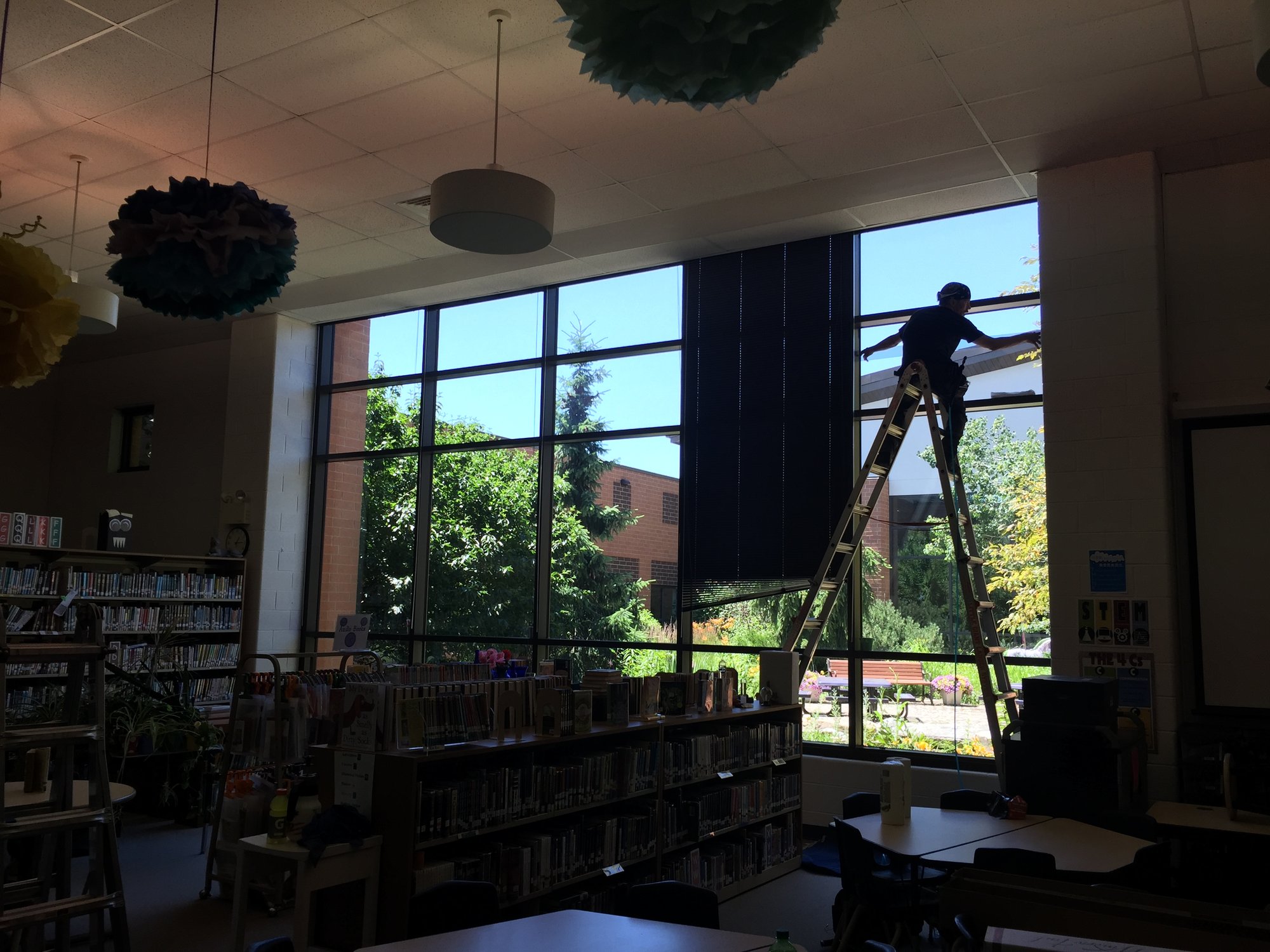
Planning and Procurement
Can Window Film Be Installed While a Building Is Occupied?
What happens when window film is installed in an occupied building: preparing the space, noise and odor, haze in new film, when to clean, and how security film attachments cure.
Read Article: Can Window Film Be Installed While a Building Is Occupied?
Planning and Procurement
What Does a Commercial Window Film Warranty Cover?
How commercial window film warranties work, and where 3M, Madico and Solar Gard differ on film terms, glass breakage limits, seal coverage, registration and what voids coverage.
Read Article: What Does a Commercial Window Film Warranty Cover?
Planning and Procurement
How Do You Replace Old or Failing Window Film?
The signs that window film needs replacing, why new film never goes over old, how old film is removed, why tempered glass is tested before scraping, and what removal adds to cost.
Read Article: How Do You Replace Old or Failing Window Film?
Talk to a commercial window film contractor
AAA Glass Tint has served the commercial window film market since 1984. We assess the glass, the frames and the openings before recommending anything, and we install our own work.