
Planning and Procurement
How Do You Replace Old or Failing Window Film?
Replace window film when it bubbles, peels, turns purple, cracks, hazes or lifts at the edges, or when the building's needs change. The old film and its adhesive come off first, because new film is not installed over old film. Removal is hand work, and tempered glass is tested before it is scraped so the glass is not scratched.
Replace window film when it starts to bubble, peel, turn purple, crack, haze over or lift at the edges, or when the way the building is used has changed and the old film no longer fits. The old film and its adhesive have to come off first, because new film is not installed over old film. Removal is careful hand work, and tempered glass is tested before anyone scrapes it, so the glass underneath is not scratched.
Key points
- The common signs of failing film are bubbling, peeling, a purple color, cracking, haze and edges lifting. Age, the wrong film for the glass, poor installation and harsh cleaning can all cause them.
- In our experience, most interior films last around 20 years and exterior films 10 to 15 years, depending on the product and conditions.
- Solar Gard’s commercial warranty for its solar control films covers adhesive failure, bubbling, cracking or crazing, delamination and peeling, so film that fails early may still be under warranty.
- Solar Gard’s glass breakage and seal warranty coverage is not available on glass with more than one window film applied, which is one reason old film always comes off first.
- We remove film with soap and water and stainless steel razor blades, switch to light duty scrubbing pads where the glass should not be scraped, and use steam on rare occasions.
- Glass makers warn that razor blades can scratch tempered glass. We test tempered glass before scraping it.
- Removal can add significantly to the price of a project, and we check for existing film on every survey.
How do you know window film needs to be replaced?
Usually you can see it. The signs we are called about are:
- bubbles or blisters between the film and the glass;
- film peeling away from the glass, or edges lifting;
- a purple or otherwise changed color;
- cracks or crazing in the film;
- haze that makes the view cloudy.
One kind of haze is not a problem. Newly installed film is applied with a mounting solution that takes time to dry, and until it does the film can look slightly cloudy or show small water beads. Solar Gard says this dries out, and that it takes longer in cold or overcast weather. That is new film settling in, not old film failing.
Film is also replaced when nothing is wrong with it. A new tenant may have different needs, or a space may be used differently than it was when the film went on: an office that needed glare control becomes a space that needs privacy, or a dark film is no longer wanted. In those cases the old film comes off and a different product goes on.
Why does window film fail?
The usual causes are age, the wrong film for the glass, poor installation and harsh cleaning. Any of them can produce any of the signs above.
Age. Every film has a lifespan. In our experience, a window film should outlast its warranty, most interior films last around 20 years, and exterior films generally last 10 to 15 years, depending on the product, how much weather and sun it takes and how it has been cared for. Exterior film lives outdoors, and that has a cost.
The wrong film for the glass. Not every film is approved for every type of glass. Solar Gard publishes a film to glass guide that lists which of its films are approved on which glass, and which need its written approval. We explain why that matters in Will Window Film Crack Your Glass? and, for coated glass, in How Do Low-E Coatings Affect Window Film?
Poor installation. A film can be the right product on the right glass and still fail early if it was not installed well.
Harsh cleaning. Solar Gard’s care instructions call for a soft cloth or synthetic sponge and mild soap and water, and warn against bristle brushes, abrasive scrubbing sponges and some paper towels, which can be coarse enough to put fine scratches in the film. Filmed glass should not be cleaned like bare glass.
Is failing film still under warranty?
It may be, and it is worth checking before paying for replacement. Solar Gard’s commercial warranty for its solar control films covers the film against adhesive failure, bubbling, cracking or crazing, delamination, demetallization and peeling, when the film was sold and installed by an authorized dealer on an appropriate glass surface. Terms differ by product: Solar Gard’s warranties page lists commercial terms from 3 years for Graffitigard anti-graffiti film to 15 years for Ecolux.
Solar Gard says every customer should be given a copy of the warranty for the film that was installed. If your building has one, find it, along with the name of the company that installed the film. A warranty claim goes through an authorized dealer, so it helps to know who put the film on.
Ownership matters too. Solar Gard’s commercial warranty for its solar control films is not transferable: it is extended to the customer who originally bought the film. If the building has changed hands since the film went on, read the original warranty before assuming the film is still covered.
Can new film go over old film?
No. The old film and its adhesive come off first, every time. New film needs clean, bare glass to bond to, and Solar Gard’s glass breakage and seal warranty coverage is not available on any glass with more than one window film applied.
Once the glass is bare, the new film is chosen like any other: checked against the manufacturer’s film to glass guidance for that glass, and seen as samples on the glass before ordering. Replacement is also a chance to choose differently. The film that went on 15 or 20 years ago may not be what the space needs now.
How is old window film removed?
By hand. Removing film is mostly elbow grease: the film comes off, and any adhesive left on the glass has to come off too before new film can go on.
Our usual method is soap and water and stainless steel razor blades. Where the glass should not be scraped, we switch to light duty scrubbing pads (3M Scotch-Brite light duty pads). On rare occasions we use steam. There is also a method known as the black bag method, which we use only on tempered glass.
Glass industry bulletins recommend against scrapers and abrasives for routine cleaning of any glass, and film removal is not routine cleaning. The adhesive has to come off, and a clean blade, used with soap and water on glass that can take it, is how we do it. Knowing which glass can take it is the part that matters, and that is where tempered glass comes in.
Removal is done by our own employees, the same as installation. We do not subcontract installation; our own crews do the work.
Can removing film scratch tempered glass?
It can. Glass makers warn about this directly. Pilkington’s technical bulletin on heat treated glass says cleaning tempered glass with razor blades can create fine scratches. A bulletin from the Glass Association of North America explains why: during heat treatment, fine glass particles from cutting and edging can stick to one or both surfaces of the glass. They can be felt but not seen, and scraping drags them across the glass, scratching and chipping it.
In our experience, the two surfaces of a tempered pane can behave very differently: one may take careful scraping while the other scratches. Which surface the old film is on depends on how the glass was installed and which side the film was applied to, and neither side should be assumed safe. So we test the glass before committing to a method. A blade on a surface that cannot take it makes an audible noise and scratches the glass immediately, which is why the test comes first. Where scraping is a risk, we use the pads or another method suited to that glass.
This matters for more than appearance. Solar Gard’s glass breakage and seal warranty coverage is not available on damaged, chipped, cracked or scratched glass, so glass scratched during removal can limit the coverage on the new film.
Is exterior or security film harder to remove?
Often, yes.
Exterior film. It can be harder to remove, depending on what kind of film it is, how long it has been on the glass and how far it has deteriorated after years of weather. Any edge sealing has to be removed as well. Exterior work can also need lifts or other access equipment.
Security film. Where security film was installed with an attachment system, the job is more involved: the old film and the silicone attachment both come off before new film and a new attachment go on. We explain attachment systems in Security Film Attachment Systems Explained. When we find a security film system that was installed incorrectly, our answer is full removal and a correct reinstallation, not a repair on top of it.
Anti-graffiti film. This film is made to be replaced. It is a sacrificial layer: when the glass is scratched or etched, the damage lands on the film, and the film is replaced instead of the glass. At the Nordstrom Rack in Kildeer in 2019, we removed etched and scratched anti-graffiti film from 35 storefront panels and installed new Solar Gard Graffitigard 6 mil film. See the Nordstrom Rack case study.
Will film removal disrupt the building?
Usually not much. Removal is water, soap and hand tools, so it is not smelly and it is not terribly loud. How much it bothers anyone depends on the customer: some do not mind crews working nearby, and some would rather not see workers at all. For those, after-hours and weekend work is available at additional cost.
How much does removing old film add to the cost?
Removal can add significantly to the price of a project, because it is hand labor, and the time it takes depends on the film, its condition and the glass. Old film turns up often enough that checking for it is part of every survey we do, so it is in the estimate rather than discovered on installation day. We cover the other factors that move price, and broad project ranges, in What Commercial Window Film Costs. If you are comparing bids, make sure each one includes removal; see How to Compare Commercial Window Film Bids.
Can you remove old film without replacing it?
Yes. Removal on its own is part of our service: for example, when a tenant moves out and the next one does not want the film.
What does a replacement project look like?
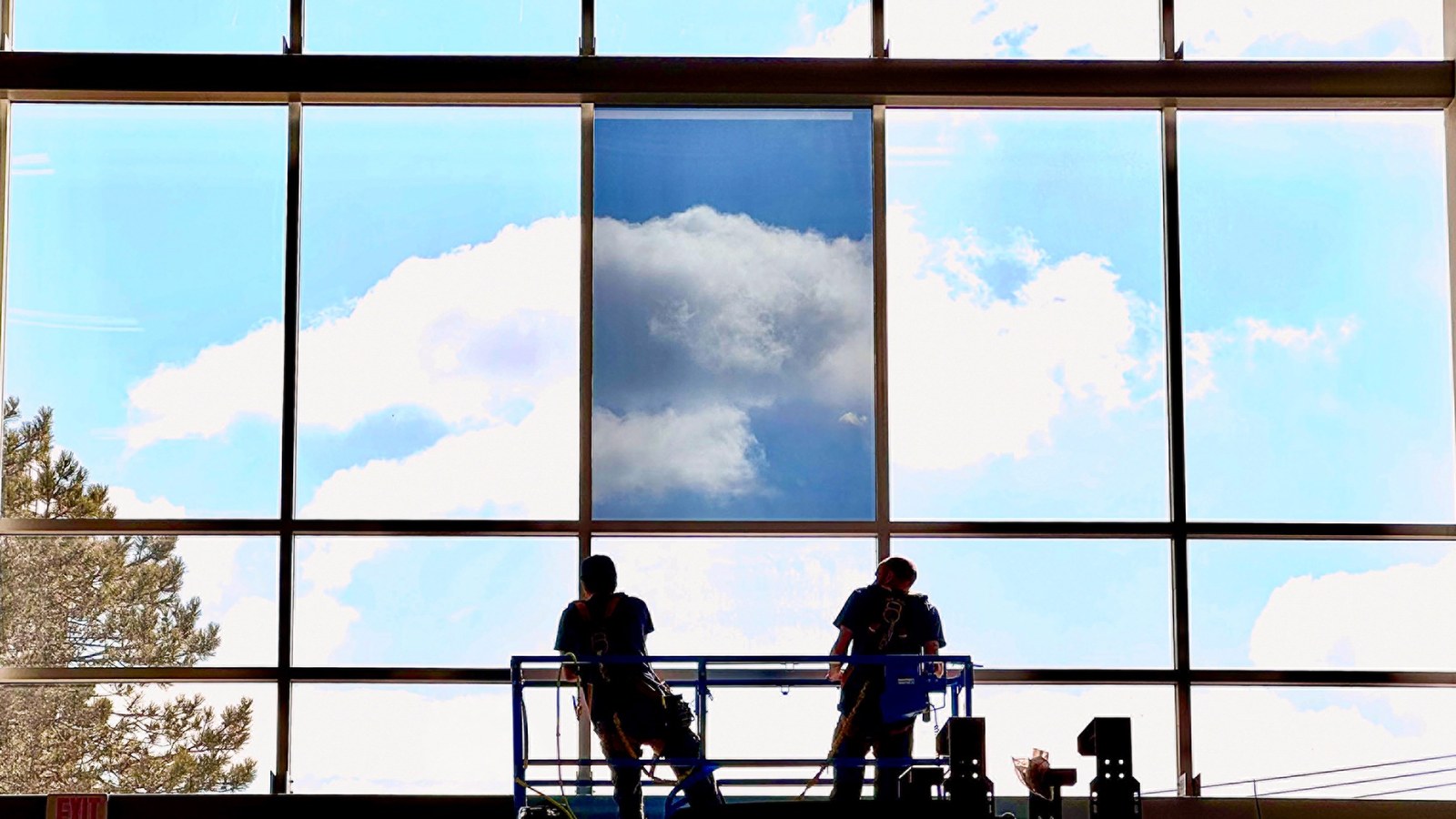
At the Oak Lawn Park District in 2026, the film on a solarium’s glass was deteriorating and needed replacement. We removed the old film from all 72 panels, prepared the glass and installed Panorama Slate 10, chosen for strong heat and glare reduction. See the Oak Lawn solarium case study, and for choosing a solar control film, Can Window Film Fix Hot Spots and Glare?
What is the next step?
Before you call, note which windows have the problem, what you see (bubbles, peeling, color, haze), roughly when the film went on, who installed it if you know, and whether you have the warranty. Then have the glass looked at in place: we look at the existing film and the glass and price removal and new film together, and tempered glass is tested before any scraping. Assessments are free. See our solar control window film service, or request a free assessment.
Sources
- Solar Gard (Saint-Gobain), Solar Control Films Limited Warranty (SK0364 09/24), section 2, reviewed October 18, 2026.
- Solar Gard (Saint-Gobain), Warranties page (commercial terms by film), updated May 2026, reviewed October 18, 2026.
- Solar Gard (Saint-Gobain), Care and Maintenance instructions, reviewed October 18, 2026.
- Solar Gard (Saint-Gobain), Film-to-Glass Guide (PDF0234 02/26), Film-to-Glass Application Disclaimers.
- Pilkington North America, Technical Bulletin ATS-186, Installation of Heat Treated Pilkington Clear and Tinted (Non-Coated) Flat Glass (January 16, 2013).
- Glass Association of North America, Glass Informational Bulletin TD 02-0402, Heat-Treated Glass Surfaces Are Different (April 2002), as reprinted in Cardinal FG Technical Service Bulletin FG02-01/16.
- AAA Glass Tint project records: Nordstrom Rack, Kildeer, Illinois (2019); Oak Lawn Park District, Oak Lawn, Illinois (2026).
Related resources
Planning and Procurement
How to Write a Commercial Window Film Specification
A practical guide to writing a commercial window film specification: CSI sections, submittals, performance on stated glass, attachment, inspection and warranty.
Read Article: How to Write a Commercial Window Film Specification
Planning and Procurement
What Commercial Window Film Costs, and What Drives the Price
Broad 2026 cost ranges for commercial window film in the Chicago area, what moves the price most, and three real project examples.
Read Article: What Commercial Window Film Costs, and What Drives the Price

Planning and Procurement
How to Compare Commercial Window Film Bids
Most gaps between window film bids come from different scopes, not different prices. What to check so you are comparing the same system on the same glass.
Talk to a commercial window film contractor
AAA Glass Tint has served the commercial window film market since 1984. We assess the glass, the frames and the openings before recommending anything, and we install our own work.