
Solar and Low-E
Can Window Film Fix Hot Spots and Glare?
Yes. Solar control window film reduces both the heat and the glare that come through sunny office glass, but they are separate jobs. A light film can cut part of the heat and keep the room bright; cutting glare means letting less light through, so the glass looks darker. The right film balances heat, glare and appearance on your glass, tested with samples first.
Yes. Solar control window film cuts both the heat and the glare coming through sunny glass, and it goes on your existing windows, usually without closing the space. The catch is that cutting glare makes the glass darker, so the right film is a balance of heat, glare and appearance, best judged with samples on your own glass.
Key points
- Solar Gard calculates glare reduction by comparing filmed glass with the same glass untreated, so glare reduction follows the drop in visible light.
- On 1/4 inch clear glass, Solar Gard rates its light Sterling 70 film at 74 percent visible light transmitted, 17 percent glare reduction and 36 percent total solar energy rejected. Its dark Panorama Slate 10 is rated at 13 percent, 86 percent and 76 percent.
- Light films reject heat by holding back part of the sun’s invisible energy: on 1/4 inch single clear glass, Panorama Hilite 70 and Ecolux 70 each pass about 70 percent of visible light and reject 54 percent of total solar energy, and Ecolux 70 adds a low-emissivity coating for winter.
- On 1/4 inch double clear (insulated) glass, exterior Sentinel Plus DX 15 is rated at 82 percent total solar energy rejected, against 64 percent for interior Panorama Slate 10, with about the same light let through. On single clear glass the two are rated one point apart.
- In our experience, interior films last around 20 years and exterior films 10 to 15 years, depending on the product and conditions.
- We leave samples on the customer’s glass for a couple of days, to be judged in morning, midday and afternoon light, in sun and in cloud.
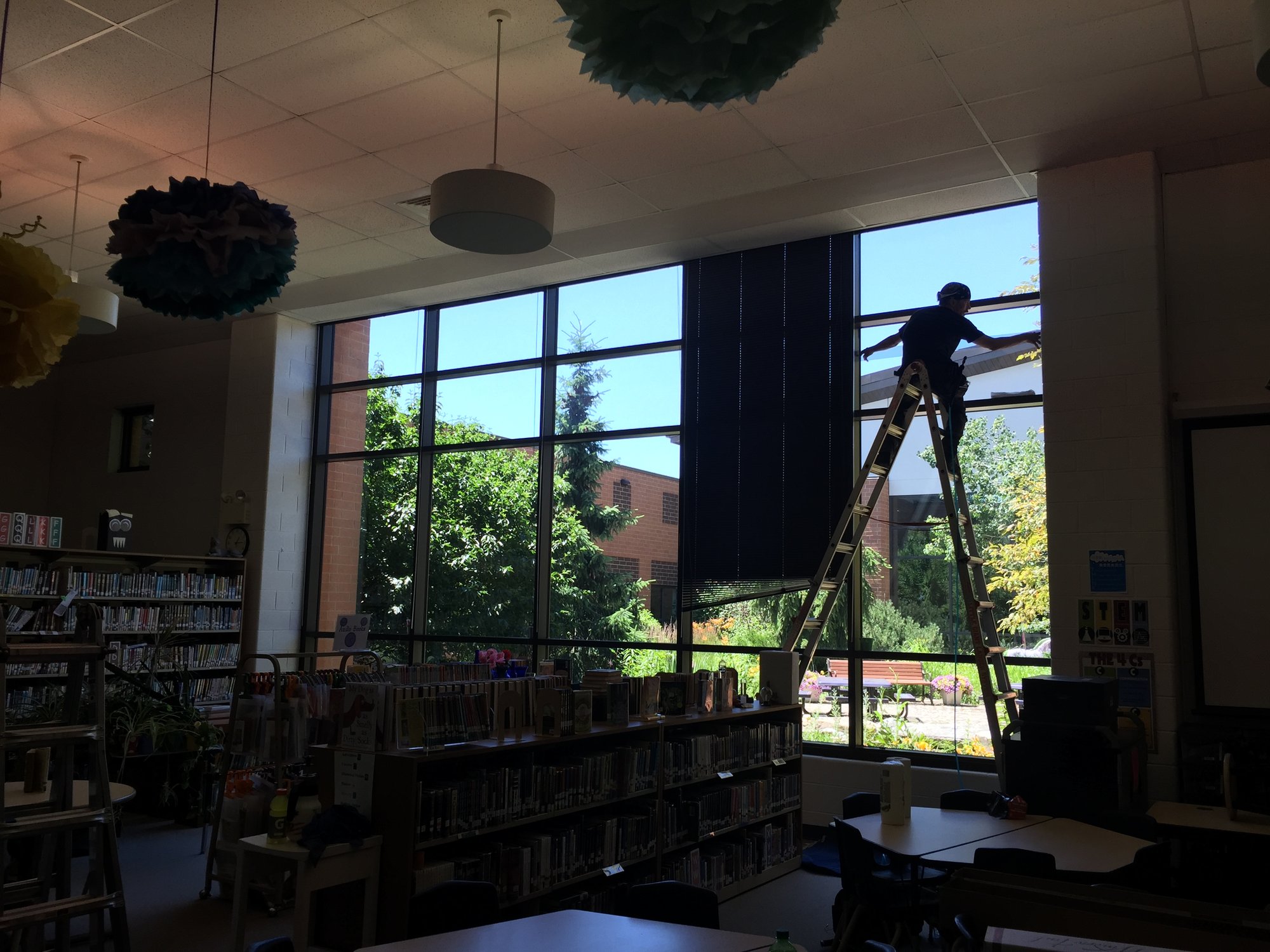
- At AIT Logistics in Palatine, we used exterior film where the glass was hard to reach from inside and interior film elsewhere on the same building.
Why do some rooms get hot spots and glare?
Large areas of glass facing the sun let in both heat and bright light. The complaints we hear vary with the building, the direction the glass faces and the people using the space: offices that are too warm in the afternoon, one side of a floor hotter than the other, monitors washed out by sunlight, glare across desks and conference tables, and tenants asking the building to do something about it. Two rooms on the same floor can need different answers, because the problem depends on which way the glass faces, how much of it there is and what people are doing near it.
Are heat and glare the same problem?
No. They are related, but film handles them differently.
Heat comes from all of the sun’s energy, including the part you feel but cannot see. The rating for it is total solar energy rejected: the share of the sun’s energy the filmed glass keeps out. Glare comes from visible light, and the only way to reduce it is to let less visible light through. Solar Gard calculates its glare reduction rating by comparing the visible light through filmed glass with the same glass untreated, so a film that passes most of the light cannot cut much glare.
That is why the highest heat rating on a data sheet is not automatically the right film. We explain each rating in our window film performance terms guide.
How can a nearly clear film keep out heat?
By treating different parts of sunlight differently. NASA notes that visible light makes up just under half of the sun’s total energy; most of the rest is infrared, which you feel as heat but cannot see. A film that holds back much of that invisible part can keep out a good share of heat while still passing most of the light. Film does this by reflecting some of the sun’s energy and absorbing some; the rest passes through. Solar Gard’s sheet for Ecolux 70 on 1/4 inch clear glass splits it as 22 percent reflected, 37 percent absorbed and 41 percent passed through. Most of the absorbed heat flows back outside, but some reaches the room, which is why its total solar energy rejected is 54 percent rather than 59. Films get there in different ways. Three Solar Gard films, all rated on 1/4 inch single clear glass, show the range:
- Panorama Hilite 70 passes 70 percent of visible light, with exterior reflectance of 8 percent, about the same as the glass alone, and rejects 54 percent of total solar energy. It keeps the look of clear glass, but it cuts glare by only 21 percent.
- Ecolux 70 passes 67 percent of visible light and also rejects 54 percent of total solar energy, but it adds a low-emissivity coating, rated at 0.09 emissivity against 0.64 for Hilite 70. That coating reduces the heat a room loses through the glass in winter: Solar Gard rates it at 41 percent less winter heat loss through that glass than the same glass without film. That is heat through the glass, not a 41 percent cut in a building’s heating bill.
- Sentinel Plus DX 15, an exterior film, takes the opposite approach. It is dark and reflective, passing 14 percent of visible light with 42 percent exterior reflectance, and rejects 75 percent of total solar energy and 84 percent of glare.
The two light films keep out the same share of the sun’s energy in summer, but only one also helps in winter, and neither does much for glare. The dark film does far more for heat and glare and changes how the building looks. No one approach is best; each is built for different priorities.
One caution when comparing products: some films are advertised by how much infrared they reject. Infrared is only part of the sun’s energy, so an infrared figure is not the same as total solar energy rejected, which is the number that describes the heat kept out. For winter performance and Low-E film, see Low-E Window Film vs. Window Replacement.
Can you cut heat without making the windows dark?
Yes, though a light film cuts much less glare than a dark one. A light film can keep out a good share of heat, as above, but glare is visible light, so a film that passes most of the light reduces glare only modestly. Solar Gard calls its Sterling films spectrally selective and describes them as rejecting heat while letting in natural light. The trade-off shows when a light film is set beside darker ones on the same glass:
| Glass and film | Visible light transmitted | Glare reduction | Total solar energy rejected |
|---|---|---|---|
| No film | 89 percent | 0 percent | 18 percent |
| Sterling 70 (light) | 74 percent | 17 percent | 36 percent |
| Panorama Slate 20 (dark) | 23 percent | 75 percent | 68 percent |
| Panorama Slate 10 (darker) | 13 percent | 86 percent | 76 percent |
Solar Gard ratings on 1/4 inch single clear glass.
The pattern is plain. The light film keeps the room bright and the view nearly unchanged and still doubles the share of the sun’s energy kept out, but it reduces glare by only 17 percent. The dark films cut glare by three quarters or more and keep out much more heat, and they make the glass noticeably darker. A light film can be the right answer where heat is the complaint and glare is not. Where sunlight is washing out screens, the film usually has to be darker, and the question becomes how dark the people using the space are willing to go.
Appearance is more than darkness. How a reflective film looks depends on which side of the glass is brighter. In daylight the outside is brighter, so the glass looks mirrored from outside and people inside see out. At night, with the lights on inside, the room is the brighter side, so people outside can see in more easily and the glass can reflect the room back to the people in it. We explain why in Does Privacy Window Film Work at Night?
Is interior or exterior film better for heat?
On insulated glass, exterior film can keep out more heat, but it is not the default choice. Solar Gard describes its Sentinel Plus exterior films as the first line of defense against solar heat and glare, and its data sheets show where that matters. Here are two dark films we installed on the same building at AIT Logistics, as Solar Gard rates them on 1/4 inch clear glass:
| Film | Visible light, single / double glass | Total solar energy rejected, single glass | Total solar energy rejected, double glass |
|---|---|---|---|
| Sentinel Plus DX 15, on the outside of the glass | 14 / 13 percent | 75 percent | 82 percent |
| Panorama Slate 10, on the inside of the glass | 13 / 12 percent | 76 percent | 64 percent |
On single glass the two are rated one point apart. On insulated glass, the exterior film is rated at 82 percent against 64 percent, with about the same amount of light let through. These are two different products, so this is a comparison, not a rule, but it fits Solar Gard’s description of exterior film as the first line of defense.
Interior film is still our usual choice when the glass can be reached from inside and the film is approved for that glass. Exterior film comes in when:
- the glass is hard to reach from inside, as on the north side at AIT Logistics;
- the glass, its Low-E coating or the risk of thermal stress rules out an interior film;
- the design of the project calls for it.
Exterior film lives outdoors, and that has a cost. In our experience, interior films last around 20 years and exterior films 10 to 15 years, depending on the product and exposure. Exterior work can also need lifts or other access equipment. Whichever side the film goes on, we check it against the manufacturer’s film to glass guidance for your glass first; for some insulated and Low-E glass, Solar Gard requires a film to glass application and its written approval for its glass breakage and seal coverage. We cover that in Will Window Film Crack Your Glass? and, for coated glass, in our article on how Low-E coatings affect window film.
How do you choose the right film for your building?
On your glass, with samples, over a couple of days. Brochures, photos and data sheets help narrow the list, but they cannot show how a film will look on your building in your light. When we visit, we put actual samples on the glass and ask the customer to leave them there and look at them in the morning, at midday and in the afternoon, and on a sunny day and a cloudy one if possible. After a couple of days, most people know which they prefer.
While the samples are up, look at:
- how dark the room feels, and how much daylight is left;
- the color of the glass and of the view through it;
- how reflective the glass looks from outside, and from inside;
- how all of that changes through the day.
A small sample shows appearance well. It cannot show how much cooler a whole room will be, or exactly how much glare a full installation will remove; that is what the data sheet ratings are for. We use both: the sample for how the film looks, the ratings for what it does, and the film to glass check for whether it is approved on that glass. We work with Solar Gard and Panorama architectural films and do not push a default product; the customer chooses. At AIT Logistics, a mockup on the building’s own glass came before the order.
Should you film every window or just the problem areas?
Our general recommendation is to film every elevation you can see at once, for two reasons.
The first is appearance. Film changes the color, darkness and reflection of glass. Filmed and unfilmed panels side by side on one face of a building usually look mismatched from outside, and often from inside.
The second is performance. A window without film is still letting in the same sun as before. Filming a few panes and expecting the space to stay comfortable is a little like closing some windows on a windy day and leaving the rest open. Film does not block all of the sun’s heat even where it is installed, so the glass left bare matters.
Partial coverage can still be the right call: when only certain rooms have the problem, when different elevations need different films, or when the budget calls for doing the work in phases. AIT Logistics used two different films on two sides of one building. Whatever the plan, film on a pane covers its whole visible opening; Solar Gard’s glass breakage and seal coverage does not extend to partial installations on a pane.
What else do people ask about heat and glare film?
Will window film stop all of the heat?
No. Even the darkest film in the tables above, Panorama Slate 10, is rated at 76 percent total solar energy rejected on 1/4 inch single clear glass, so part of the sun’s energy still comes through.
Will film stop glare on computer screens?
It reduces it, by reducing the light coming through the glass. How much depends on the film’s glare reduction rating, from 17 percent for Sterling 70 to 86 percent for Slate 10 on 1/4 inch single clear glass. A very light film does little for screen glare.
Can film be installed without closing the space?
Usually, yes. At Costco in Glenview, we installed Panorama Slate 20 on about 500 square feet of entrance and tire shop glass before the store opened. After-hours and weekend installation is available at additional cost.
Can old film be replaced with a better one?
Yes. At the Oak Lawn Park District, we removed deteriorating film from 72 solarium panels and installed Panorama Slate 10 for strong heat and glare reduction. See the Oak Lawn solarium case study.
What is the next step?
Note which rooms have the problem, which way their glass faces and what time of day it is worst. Then have the glass looked at in place, with samples on it. We do not subcontract installation; our own crews do the work. See the AIT Logistics case study and the Costco Glenview case study, our solar control window film service, or request a free assessment.
Sources
- Solar Gard (Saint-Gobain), Sterling 70 data sheet (SK0314ST70 03/24), interior application, reviewed October 14, 2026.
- Solar Gard (Saint-Gobain), Sterling spectrally selective film product page, reviewed October 14, 2026.
- Solar Gard (Saint-Gobain), Panorama Slate 10 data sheet (SK0314PANSL1 09/20).
- Solar Gard (Saint-Gobain), Panorama Slate 20 data sheet (SK0314PANSL2 09/20).
- Solar Gard (Saint-Gobain), Sentinel Plus DX 15 data sheet (SK0314SPDX15 02/22), exterior application.
- Solar Gard (Saint-Gobain), Sentinel Plus exterior window film product page, reviewed October 14, 2026.
- Solar Gard (Saint-Gobain), Panorama 2 Mil Hilite 70 data sheet (SK0314PAN2HL7 09/20).
- Solar Gard (Saint-Gobain), Ecolux 70 product sheet (PDF0314ECX70 04/13), interior application.
- NASA Earth Observatory, Solar Radiation and Climate Experiment (SORCE) Fact Sheet, last updated November 25, 2025.
- Solar Gard (Saint-Gobain), Film-to-Glass Guide (PDF0234 02/26).
- Data sheet figures are Solar Gard’s ratings on the glass named; results on other glass differ.
- AAA Glass Tint project records: AIT Logistics, Palatine, Illinois (2024); Costco Wholesale, Glenview, Illinois (2026); Oak Lawn Park District, Oak Lawn, Illinois (2026).
Related resources
Solar and Low-E
Low-E Window Film vs. Window Replacement
Low-E window film improves sound windows at a fraction of the cost and disruption of replacement. When it makes sense, when it does not, and what the warranties cover.
Talk to a commercial window film contractor
AAA Glass Tint has served the commercial window film market since 1984. We assess the glass, the frames and the openings before recommending anything, and we install our own work.