
Security and Safety
Security Film, Laminated Glass or Polycarbonate for School Entrances
For many existing school entrances, the practical upgrade is clear security film with a perimeter attachment system on the glass already in the doors and sidelights. Without the attachment, film is a glass safety product, not intrusion delay. When an entrance needs ballistic resistance or a very high level of forced entry resistance, the right answer is laminated security glazing or a polycarbonate based system in a frame rated to hold it. The choice depends on the threat and on the actual glass and frame in each opening.
Which is right for a school entrance: security film, laminated glass or polycarbonate?
For many existing school entrances, the practical upgrade is clear security film with a perimeter attachment system, applied to the glass already in the doors and sidelights. When the goal is ballistic resistance or a very high level of forced entry resistance, film is the wrong product, and the answer is laminated security glazing, a polycarbonate based system or another engineered glazing system installed in a frame rated to match it. The right choice depends on what the entrance needs to resist, and on the glass and frame that are actually there.
One point applies before any of the comparisons: AAA Glass Tint does not treat film without an attachment as a security system. Film on the glass alone retains fragments and improves glass safety. Delaying an intrusion requires the film to be attached to the frame.
Key points
- For many existing entrances, the practical upgrade is clear security film attached to the frame, on the glass already there.
- AAA Glass Tint does not treat film without an attachment as a security system.
- Our typical entrance system is 8 mil clear Armorcoat with a four sided structural silicone wet glaze.
- For ballistic resistance or very high forced entry resistance, the answer is laminated, polycarbonate or other engineered glazing in a rated frame.
- A pair of doors with sidelights is generally a one day installation, and as of October 2026 generally falls in the low thousands of dollars.
- ASTM F3561 ratings belong to full tested assemblies and do not transfer to retrofit film.
The three options are not interchangeable versions of the same thing. Film is added to existing glass. Laminated and polycarbonate glazing replace it, and usually bring the frame into the conversation too.
| Option | What it is | Where it fits | Main limits |
|---|---|---|---|
| Security film with attachment | A safety film bonded to the existing glass and connected to the frame with structural silicone or a mechanical system | Retrofit delay on existing entrances where the glass and frame can take an attachment | Does not strengthen the frame, anchors, glass bite or hardware; not ballistic |
| Laminated security glass | Two or more lites of glass bonded with an interlayer, replacing the existing glass | Higher forced entry ratings, and ballistic ratings in specific tested constructions | Replacement work; the frame has to be rated to hold it |
| Polycarbonate based glazing | Polycarbonate sheet, or glass clad polycarbonate laminates | Engineered security and ballistic glazing systems | Exposed plastic surfaces lack the abrasion and chemical resistance of glass; framing has to match |
What is usually in a school entrance today?
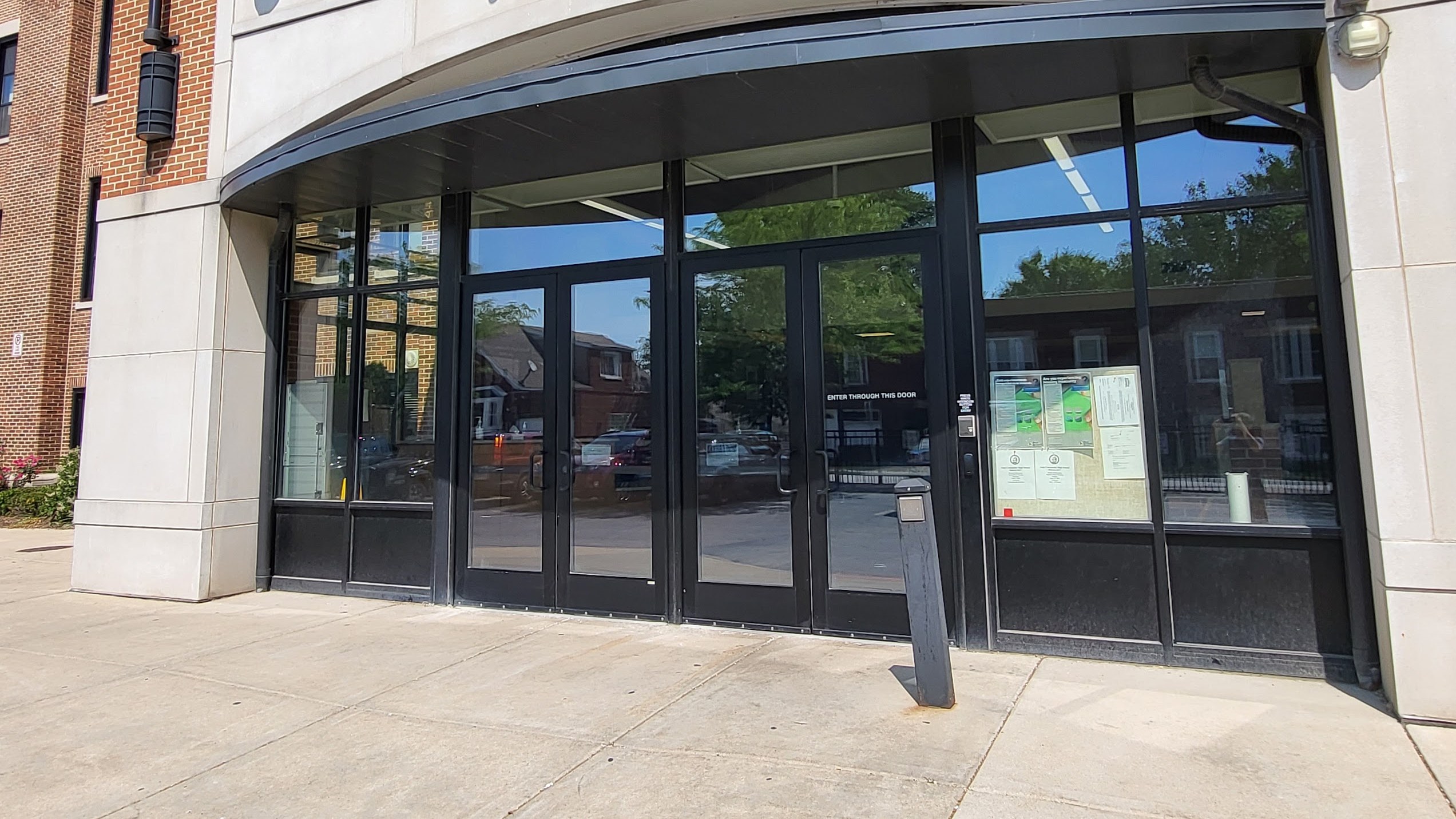
In the Illinois schools we work in, most entrances are aluminum storefront systems with tempered safety glass in the doors and sidelights. Older schools are rarely that tidy. It is common to find original glass beside replacement panels, different glass thicknesses in the same entrance, and older frames or hardware.
That is why the first step is identifying what is there, pane by pane, before anyone specifies a system. The National Glass Association’s school security glazing paper makes the same point from the manufacturer’s side: base the selection of surface applied safety and security film on the performance requirement and the window system’s capability, including the attachment method, the glass type and thickness, single or multi pane construction, window size and frame type.
What does security film do on tempered entrance glass?
Tempered glass is a safety glass. According to the International Window Film Association, when it breaks it falls into small cubical pieces rather than large sharp shards, which greatly reduces the chance of serious injury. The same property is the problem for security: once tempered glass breaks, it can fall out of the frame and leave an opening.
IWFA’s education guide is direct about what that means for film. On tempered glass, a more robust method than film on the glass alone is needed to keep the broken glass from falling out of the frame. IWFA also reports that safety film performed better on heat treated and tempered systems than on annealed glass, especially when attachment systems are used.
That is why the attachment is not optional on a school entrance. Film helps retain the broken tempered glass, and the attachment connects the filmed glass to the frame so it is more likely to remain in the opening. Without the attachment, the film is a glass safety product, not intrusion delay. For a standard entrance, AAA Glass Tint’s typical system is 8 mil clear Armorcoat with a four sided wet glaze attachment using structural silicone. One Northern Illinois district used 8 mil clear Armorcoat with a DOWSIL 995 attachment on 1,205 exterior panels across nine buildings, installed over six summer breaks; see our school district security film case study. We cover what film can and cannot do in detail in What Security Window Film Can and Cannot Do, and the attachment options in Security Film Attachment Systems Explained.
When is laminated security glass the better choice?
Laminated glass is two or more lites of glass bonded together with an interlayer. IWFA describes its most significant benefit as its ability to keep its structural integrity after it is broken. The National Glass Association states that significant protection from forced entry can be achieved with standard two ply laminated glass using the proper thickness interlayer, and that forced entry resistant glazing may be used in areas with a high risk of prolonged attack or in critical areas such as entry vestibules.
Laminated security glazing can also be tested and rated in ways film cannot. The NGA paper describes several of the test methods used:
- UL 972, a multiple impact test using a 5 lb steel ball, intended to evaluate resistance to repeated impact similar to attempted burglary.
- ASTM F1233, which rates resistance to penetration using a range of hand tools and, in some sequences, ballistic attack.
- ASTM F3038, a timed impact test designed to simulate a spontaneous mob using readily available hand tools.
- ASTM F3561, in which the glazing is first weakened by gunfire and then struck repeatedly with a 100 lb impactor.
- UL 752, which evaluates ballistic resistance.
When a school needs ballistic resistance, or forced entry resistance beyond what film and attachment can realistically provide, AAA Glass Tint recommends laminated security glazing, polycarbonate or another engineered glazing system rather than overselling film. IWFA’s own position supports that line: it expresses concern about any specification that relies on window film as a primary component of bullet resistant glazing.
The tradeoff is that this is replacement work, and pricing is set by the replacement. Cost and lead time depend on the glass makeup, the framing, the opening sizes, access and the supplier’s schedule, which is why a realistic number comes from a glazing contractor’s quote for your specific openings rather than from a published average.
Where does polycarbonate fit?
Polycarbonate shows up in school security glazing in two main forms: as a sheet product, and as a layer inside laminates such as glass clad polycarbonate. The NGA lists glass clad polycarbonate laminates and laminated polycarbonates among the constructions used in bullet resistant glazing, and IWFA notes that laminated glass, glass clad polycarbonate and polycarbonate sheet can be engineered to withstand significant blast loads, provided adequate framing rebates and anchoring are provided.
The caution is the surface. Both NGA papers advise careful review of any glazing with exposed plastic on the interior side, because these plastics do not have the chemical and abrasion resistance of glass. In a school entrance that sees daily cleaning, backpacks and hands, that is a practical question to raise with the glazing supplier, along with the cleaning products the building uses.
Does the frame matter as much as the glass?
Yes. A security rating belongs to a tested system, and the frame is part of the system.
For replacement glazing, the NGA advises making sure the framing system is rated to the necessary performance level or higher so it can hold the glass and resist entry, and names ASTM F476, F588 and F842 as framing performance standards. Upgrading the glass in a frame that cannot hold it moves the weak point rather than removing it.
For film, the limit is stated plainly by a glazing system manufacturer, Oldcastle BuildingEnvelope, writing for the American Institute of Architects: film does not strengthen the frame, anchors, glass bite or hardware. The same article describes film as better than no protection, especially in retrofit situations where replacing the glass and framing is not an option. That is a fair summary of where film sits.
It also explains why ASTM F3561 ratings do not transfer to film. The standard evaluates a full assembly of glass, framing, anchoring and hardware. IWFA states that F3561 was not designed to evaluate retrofit film applied to existing door, entry or window glass, and that using it in a bid specification or submittal for retrofit film is not appropriate. We explain what the standard actually tests and how to check an F3561 claim in ASTM F3561 and Security Window Film: What the Standard Tests.
Should the age of the building decide?
Age changes the odds, not the answer. Older buildings are more likely to have weaker framing, deteriorated seals, unusual glass configurations and decades of piecemeal replacements. Newer buildings are more likely to already have modern safety glazing, and some already have laminated glass.
Neither of those is a substitute for looking. AAA Glass Tint bases its recommendation on the condition of the actual glass and frame in each opening, not on the year the building went up.
What does installing film on a school entrance involve?
A typical entrance, a pair of doors with sidelights, is generally a one day installation for our crew. Larger vestibules, or entrances with many individual panes, take longer.
Schedule matters as much as duration. The structural silicone used in a wet glaze attachment is soft when first installed, so AAA Glass Tint schedules school entrance work when students are not present. Cure continues after installation. DOWSIL 995 lists a curing time of 7 to 14 days and full adhesion at 14 to 21 days at 77 degrees Fahrenheit and 50 percent relative humidity, with temperature and humidity affecting the cure. Solar Gard also recommends waiting 30 days before cleaning newly installed film.
On cost, as of October 2026 a typical entrance with 8 mil clear Armorcoat and a four sided wet glaze attachment generally falls in the low thousands of dollars. That makes it a relatively small security project, but the actual price depends heavily on the number and size of the individual panes and the amount of attachment work.
How does entrance glazing fit the rest of a school’s security plan?
Glazing is a delay measure. The Cybersecurity and Infrastructure Security Agency’s K-12 School Security Guide organizes school physical security around detection, delay and response, applied in layers from the grounds perimeter to the building interior so that no single measure is a point of failure. Delay only has value if detection and response are working: someone has to know the entrance is under attack and act in the time the glazing buys.
That is why entrance glazing decisions belong alongside access control, door hardware and vestibule design. AAA Glass Tint does not design or specify those systems, but we point out issues we see with them during an assessment and coordinate with the school’s security, facilities, glazing, hardware or access control professionals.
One small planning note: the NGA points out that security glazing is designed to stay intact after breakage, which can add time and effort when firefighters need to ventilate a building. Schools should consider making local fire and emergency personnel aware when entrance glazing has been upgraded.
What maintenance does a security film system need?
Periodic visual inspection. Check the film, the perimeter attachment, the sealant and the surrounding glazing for damage, separation, deterioration, or anything that has been changed. Any glass replacement, frame work, hardware change or damage around a protected opening should trigger another inspection, because the system only performs as installed.
Routine cleaning matters too. Solar Gard recommends a soft cloth or clean synthetic sponge with a mild soap solution, and warns against bristle brushes, abrasive scrubbing sponges and cleaning materials contaminated with dirt.
How should a school make the decision?
Start with four questions, in this order.
- What does the entrance need to resist? If the requirement is ballistic, or forced entry resistance beyond what film and attachment can provide, plan on replacement glazing in a rated frame.
- What is actually in the opening? Identify the glass type and thickness in every pane, and the condition of the frame and glazing stops.
- Can the frame take the upgrade? Film needs a frame that can accept an attachment. Replacement glazing needs a frame rated to hold it.
- What else is part of the plan? Confirm how the entrance glazing works with access control, hardware, vestibule design, emergency response and the local fire department.
If you are looking at grant funding, some programs list security window film as an allowable cost, including the U.S. Department of Justice School Violence Prevention Program for public school districts. We explain the programs and deadlines in Security Window Film Grants for Schools, Churches and Nonprofits.
If film is the right answer, the next step is an on site assessment of each opening; request a free assessment. If it is not, the next step is a quote from a glazing contractor for a tested system, and a contractor who tells you that plainly is doing the job properly.
Sources
- National Glass Association, Glass Technical Paper FB71-24, School Security Glazing, updated August 2024.
- National Glass Association, Glass Technical Paper FB43-14, Security Glazing, 2020.
- International Window Film Association, Safety and Security Education Guide, revised October 1, 2025.
- International Window Film Association, Statements on Protection from and against Ballistics.
- Oldcastle BuildingEnvelope for the American Institute of Architects, ASTM F3561: A new way to comprehensively evaluate forced-entry resistance, April 10, 2026.
- Cybersecurity and Infrastructure Security Agency, K-12 School Security Guide, 3rd Edition, February 2022.
- Dow, DOWSIL 995 Silicone Structural Sealant Technical Data Sheet, Form No. 62-1260-01-0720 S2D.
- Solar Gard, Window Film Care Instructions.
Related resources
Security and Safety
What Is Anti-Graffiti Window Film, and When Is It Worth It?
What anti-graffiti window film protects against, how sacrificial film is replaced, how 3M and Solar Gard films and warranties compare, and why it is not security film.
Read Article: What Is Anti-Graffiti Window Film, and When Is It Worth It?
Security and Safety
ASTM F3561 and Security Window Film: What the Standard Tests
What ASTM F3561 tests, why it does not rate retrofit window film, the current edition, and what to ask when a specification or bid cites it.
Read Article: ASTM F3561 and Security Window Film: What the Standard Tests
Security and Safety
Smash-and-Grab Protection for Storefronts and Video Gaming Locations
What security window film can and cannot do against smash-and-grab break-ins at storefronts and Illinois video gaming locations, and how the attachment changes it.
Read Article: Smash-and-Grab Protection for Storefronts and Video Gaming Locations
Talk to a commercial window film contractor
AAA Glass Tint has served the commercial window film market since 1984. We assess the glass, the frames and the openings before recommending anything, and we install our own work.